
EU LISTERIA REGULATION 2026: WHY WATER ACTIVITY MATTERS FOR READY-TO-EAT FOOD SAFETY
Since July 1, 2026, the regulatory requirements for Listeria monocytogenes in ready-to-eat foods have become stricter in the European Union. For QC, QA and food safety teams, this is more than a regulatory update. It is a clear signal that scientific evidence, shelf-life validation and documented product control are becoming even more important for ready-to-eat food manufacturers. Regulation (EU) 2024/2895 amends Regulation (EC) No 2073/2005 and applies from July 1, 2026.
The central question is no longer only whether Listeria monocytogenes is detected at the time of production. The key question is whether the product can support growth during its entire shelf life. If a ready-to-eat food can support the growth of Listeria monocytogenes, the food business operator must be able to demonstrate that the level will not exceed 100 CFU/g throughout the entire shelf life. If this evidence is not available, the stricter criterion applies: Listeria monocytogenes must not be detected in 25 g.
This makes the quality of the scientific evidence more important. End product testing alone gives only limited information about how a product behaves during storage. Manufacturers need measurable and reproducible parameters that help demonstrate whether growth is possible during shelf life. For many ready-to-eat products, water activity is one of these key parameters.
Ready-to-eat foods are consumed without any additional heat treatment before consumption. Any contamination that occurs after processing may therefore remain in the product until it reaches the consumer. Listeria monocytogenes is particularly relevant because it can grow at refrigeration temperatures, survive in food production environments and persist on food contact surfaces. This makes it a significant concern for products that are sliced, filled, assembled, packaged or otherwise exposed after processing.
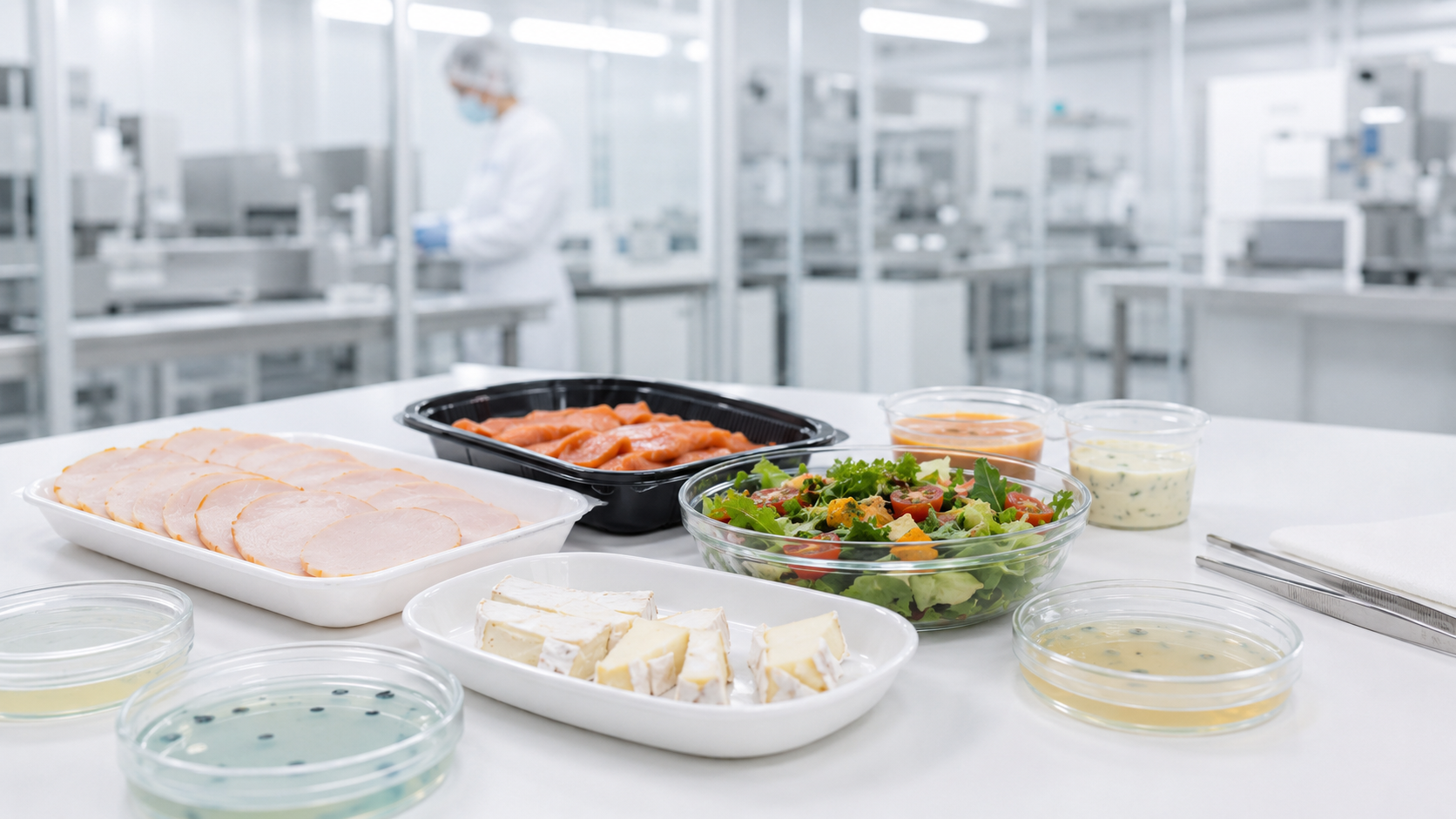
Relevant product categories include soft and fresh cheeses, cooked meats, sliced meats and deli products, smoked or marinated fish, refrigerated ready meals, sandwiches, salads, sauces, spreads, desserts, creams and plant-based ready-to-eat products. For vulnerable consumer groups such as pregnant women, newborns, elderly people and immunocompromised individuals, listeriosis can lead to severe disease. For food manufacturers, Listeria control is therefore a matter of consumer safety, regulatory compliance and business continuity.
The regulatory focus is shifting further toward scientific demonstration. For QC and QA teams, this means that the product matrix must be understood and relevant parameters must be controlled. The data must be traceable and suitable for internal decisions, audits and regulatory discussions. In practical terms, one question becomes central: can the manufacturer demonstrate that the ready-to-eat product does not support Listeria growth throughout its shelf life?
Water activity is sometimes confused with moisture content, but the two parameters describe different aspects of water in a product. Moisture content describes the total amount of water present in a sample. Water activity describes how much of that water is available for microorganisms, chemical reactions and physical changes.
From a food safety perspective, this distinction is important. A product can contain a relatively high amount of water and still be more stable if much of that water is bound. Another product with a similar moisture content may carry a higher microbiological risk if its water activity is higher. For QC teams, water activity is therefore a more direct parameter for assessing microbial growth potential than moisture content alone.
Listeria monocytogenes requires sufficient available water to grow. When water activity is reduced below the growth-relevant range, the bacterial cell can no longer maintain its water balance and turgor pressure. Growth is limited or stopped. In practical food safety work, water activity values around 0.92 are commonly used as an important reference point for Listeria monocytogenes. If a product is consistently controlled below this range, it can support the scientific argument that the product does not support Listeria growth.
However, water activity should not be considered in isolation. It must be evaluated together with pH, temperature, formulation, packaging, shelf life, hygiene, environmental monitoring, process control and, where required, predictive modelling or shelf-life studies. The value of water activity measurement is that it provides a measurable and reproducible parameter. It helps convert product knowledge into documented evidence.
Now that the new requirements apply, QC and QA teams should assess whether water activity is already integrated into the Listeria control strategy and whether the available data are sufficient. A robust water activity control concept should include product-specific water activity limits, validated measurement methods, suitable water activity instruments, routine testing for product release, documented calibration and instrument checks, trend analysis across batches and production lines, integration into HACCP and food safety documentation, and clear evidence for audits, authorities and customer requirements.
This is especially relevant for ready-to-eat products with complex matrices, variable raw materials or multiple components. In such products, microbiological end product testing alone may not provide enough information about growth potential during shelf life. Water activity adds a relevant control parameter that supports a more complete and transparent risk assessment.
A practical example is a chilled, smoked or salted product. Through salt, formulation and process design, water activity can be reduced. Without documented water activity data, however, this safety argument is difficult to support. With routine water activity measurement, manufacturers can demonstrate whether the product remains within a defined range. This helps support the classification of whether the product supports Listeria growth or not.
For QC teams, this reduces uncertainty in technical discussions. For production teams, it provides additional process information. For the company, it strengthens the basis for compliance, audit readiness and recall prevention.
Novasina develops water activity measurement solutions for food safety and quality control. The instruments are designed to help food manufacturers measure and document water activity values and integrate them into existing quality systems. For ready-to-eat food production, this can support product release decisions, shelf-life evaluation, HACCP documentation, audit preparation, process and formulation control, and the assessment of Listeria growth risk.
The requirements for ready-to-eat food manufacturers are now stricter. Companies that want to control Listeria risk need more than isolated end product testing. They need to understand how their product behaves during shelf life and they need reliable data to support that assessment.
Water activity is one of the relevant parameters in this context. It connects scientific risk assessment with practical process control and helps QC and QA teams make decisions that are measurable and traceable.
Water activity alone does not replace a full Listeria control strategy. It should be understood as one important scientific parameter within a broader food safety system. However, if water activity is not yet part of the Listeria control strategy, now is the right time to evaluate how it can support product safety, shelf-life validation and regulatory documentation.


