
WATER ACTIVITY IN PET FOOD: SAFETY, SHELF LIFE, PALATABILITY, TEXTURE AND YIELD
Your pet food is still within its moisture specification, but a customer finds mold in the bag. A dry kibble develops an unpleasant rancid smell before the end of its intended shelf life. A semi-moist treat becomes hard during storage, while crunchy pieces in a multi-texture product become soft. Or the same dryer settings that worked perfectly last month suddenly produce batches outside specification.
These may look like unrelated problems, but they often have something in common: the way water behaves inside the product.
For pet food manufacturers, moisture content alone cannot describe that behavior. The more relevant parameter for many safety, quality and shelf-life decisions is water activity (aw).
Water activity helps manufacturers understand whether microorganisms can grow, whether a product is likely to gain or lose moisture, how texture may change, how formulation affects stability and why drying a product further does not necessarily make it better. Used correctly, it also connects R&D, incoming ingredient control, processing, final QC and packaging.
The key is not to achieve the lowest possible water activity. It is to identify the optimum water activity range for the specific product and then keep the product inside that range throughout manufacturing, distribution and shelf life.
Different Pet Foods Fail for Different Reasons
Wet food, semi-moist treats and dry kibble should not be managed as though they were the same product simply because they all fall within the pet food category.
A moist canned or fresh pet food normally contains highly available water, making microbial control, processing and storage conditions particularly important. Semi-moist foods and soft treats operate in an intermediate region where microbial stability must often be balanced against softness, palatability and formulation. Dry kibble is normally much lower in aw, meaning microbial proliferation may no longer be the dominant shelf-life mechanism; moisture uptake, loss of crispness, lipid oxidation and aroma deterioration can become more important. Multi-component products introduce yet another problem because water can migrate between components with different water activities.
A strong water activity specification therefore starts with a simple question:
What is most likely to make this particular pet food unacceptable?
For QA, that may be microbial growth or a recall risk. For R&D, it may be maintaining a soft treat without compromising stability. For production, it may be avoiding excessive drying and inconsistent batches. For packaging teams, it may be keeping kibble crisp during humid distribution conditions. And for the pet owner, the failure may simply be obvious: the food smells wrong, looks moldy or the pet refuses to eat it.
Water activity connects these different perspectives through one measurable thermodynamic property.
Real Pet Food Products Cover a Wide Water Activity Range
Measurements reported in Novasina’s existing pet food study demonstrate how strongly aw varies between product categories.
| Pet Food Sample | Water Activity |
|---|---|
| Moist Canned Pet Food | 0.994 |
| Prepared Meals Pet Food | 0.830 |
| Imitation Bone Treat | 0.679 |
| Imitation Bacon Treat | 0.669 |
| Dry Kibbles Dog Food | 0.493 |
| Dry Kibbles Cat Food | 0.459 |
Table 1. Water activity survey of different pet food samples measured in the original Novasina study.
The differences are substantial. A moist canned product measured almost 1.00 aw, whereas the two dry kibbles measured below 0.50 aw. The semi-moist and treat products occupied the region in between.
These values should not be interpreted as universal product specifications. Instead, they illustrate an important point: the ideal water activity depends on the product and its intended behavior.
The original Novasina dataset also reported moisture content and showed that the relationship between moisture content and aw differed significantly among products. Before republishing those moisture values, however, the stated moisture-basis notation in the original table should be verified.
Why Moisture Content Alone Can Miss the Problem
Moisture content answers a quantitative question:
How much water is present?
Water activity answers a different question:
What is the thermodynamic state of that water and how available is it to drive microbial, chemical and physical change?
Two pet foods can contain similar percentages of moisture while having different water activities because proteins, starches, salts, sugars, glycerol, fibers and other formulation components interact differently with water. Conversely, two products can have similar aw values while containing very different amounts of total water.
The relationship between moisture content and water activity is described by a moisture sorption isotherm, and that relationship is specific to the formulation and temperature.
This is precisely why a long-established moisture specification can suddenly become unreliable after a formulation, ingredient or processing change. The moisture percentage may remain close to the historical target while the water activity — and therefore the product’s stability — has changed. For microbial risk, texture and shelf-life decisions, that difference matters.
What Is Water Activity?
Water activity describes the thermodynamic state of water in a product and is defined as the ratio between the equilibrium vapor pressure of water above the product and the vapor pressure of pure water at the same temperature:
aw = p / p₀
Pure water has a water activity close to 1.00.
Water activity is also directly related to equilibrium relative humidity:
ERH (%) = aw × 100
A pet food at 0.50 aw therefore tends toward equilibrium with an environment of approximately 50% relative humidity at the same temperature.
This becomes extremely important during storage. If a dry kibble at 0.40 aw is exposed for sufficient time to an atmosphere at 70% relative humidity, there is a thermodynamic driving force for the product to absorb moisture. How quickly that happens depends on packaging, temperature, product structure and other factors, but the direction of moisture transfer is determined by the water activity difference.
The Thermodynamics Behind Water Activity
Water activity is rooted in chemical potential and Gibbs free energy. The chemical potential of water relative to a reference state can be expressed as:
Δμw = RT ln(aw)
where Δμw is the difference in chemical potential, R is the universal gas constant, T is absolute temperature and aw is water activity.
This is why describing water activity simply as “free water” can be misleading.
A water activity of 0.50 does not mean that 50% of the water is free, nor does it mean that the water contains exactly 50% of the energy of pure water. Water activity describes the thermodynamic state of the water and therefore its tendency to participate in processes such as moisture transfer and microbial growth.
This scientific distinction is the reason aw can provide information that total moisture content cannot.
Water Activity and Microbial Safety in Pet Food
Water activity has a particularly important role in animal-food safety because microorganisms require available water to grow.
As aw decreases, microorganisms experience increasing osmotic stress. Eventually, each organism reaches a minimum water activity below which it can no longer proliferate. This does not mean that the organism necessarily dies; it means that the environment no longer supports its growth.
Current FDA Guidance for Industry #245 classifies animal foods into three broad aw categories:
| Water Activity | FDA Category |
|---|---|
| Above 0.85 aw | Moist animal food |
| 0.60–0.85 aw | Intermediate-moisture animal food |
| Below 0.60 aw | Low-moisture animal food |
Table 2. Water Activity levels and related FDA Category
FDA lists soft or semi-moist pet food, dry pet food such as kibble and dog biscuit treats among examples relevant to the intermediate-moisture category, while foods below 0.60 aw are classified as low-moisture animal foods. FDA also states that 0.85 aw is generally considered the safe cutoff for growth of bacterial pathogens, although the appropriate food-safety control depends on the actual product and process.
| Microorganism | aw limit |
| Clostridium botulinum E | 0.97 |
| Pseudomonas fluorescens | 0.97 |
| Escherichia coli | 0.95 |
| Clostridium perfringens | 0.95 |
| Salmonella spp. | 0.95 |
| Clostridium botulinum A B | 0.94 |
| Vibrio parahaemoliticus | 0.94 |
| Bacillus cereus | 0.93 |
| Rhizopus nigricans | 0.93 |
| Listeria monocytogenes | 0.92 |
| Bacillus subtilis | 0.91 |
| Staphylococcus aureus (anaerobic) | 0.9 |
| Saccharomyces cerevisiae | 0.9 |
| Candida | 0.88 |
| Staphylococcus aureus (aerobic) | 0.86 |
| Microorganism | aw limit |
| Penicillum expansum | 0.83 |
| Penicillum islandicum | 0.83 |
| Debarymoces hansenii | 0.83 |
| Aspergillus fumigatus | 0.82 |
| Penicillum cyclopium | 0.81 |
| Saccharomyces bailii | 0.8 |
| Penicillum martensii | 0.79 |
| Aspergillus niger | 0.77 |
| Aspergillus ochraceous | 0.77 |
| Aspergillus restrictus | 0.75 |
| Aspergillus candidus | 0.75 |
| Eurotium chevalieri | 0.71 |
| Eurotium amstelodami | 0.7 |
| Zygosaccharomyces rouxii | 0.62 |
| Monascus bisporus | 0.61 |
Table 3. Water activity lower limits for growth for common spoilage organisms
The historical microbiological literature provides further detail. Minimum growth limits vary between species: Salmonella, pathogenic E. coli, Listeria monocytogenes and Clostridium botulinum generally require relatively high aw, whereas certain yeasts and molds can grow at substantially lower values. At approximately 0.60 aw and below, microbial proliferation is generally considered unable to occur.
Low Water Activity Controls Growth — It Does Not Sterilize Pet Food
Dry kibble can have an aw too low to support the growth of Salmonella while still containing viable Salmonella. That distinction is critical.
Low water activity is a growth-control mechanism, not necessarily a lethality step. Pathogens can survive for extended periods in dry food environments, and pet food creates an additional human-health consideration because consumers handle the product, feeding bowls and contaminated surfaces in the home.
FDA’s current animal-food guidance explicitly notes that contaminated dry pet food has been linked to human salmonellosis outbreaks and states that pet food contaminated with Salmonella may be considered adulterated when it will not subsequently undergo a commercial process capable of killing the organism.
For manufacturers, the conclusion is straightforward:
Do not confuse “cannot grow” with “is not present.”
Water activity should therefore form part of a complete food-safety strategy that includes appropriate hazard analysis, validated lethality or process controls where necessary, sanitation, prevention of post-process contamination and verification. FDA’s Preventive Controls for Animal Food rule under 21 CFR Part 507 requires facilities subject to the rule to identify relevant hazards and implement risk-based controls where needed. That is scientifically stronger than treating a single aw threshold as a universal declaration of product safety.
Dry Kibble: When Microbial Growth Is No Longer the Main Shelf-Life Problem
Once a dry pet food is sufficiently low in water activity that microbial proliferation is controlled, shelf life does not become unlimited. The dominant failure mechanism simply changes.
Dry kibble typically contains fats, and those fats are often applied to the surface to improve flavor, aroma, nutrient density and palatability. This makes oxidative stability particularly important. Lipid oxidation can generate volatile compounds that produce rancid or stale odors and flavors. The product may remain microbiologically stable and look visually normal, yet the owner notices an unpleasant smell or the animal begins to reject it. This is a fundamentally different shelf-life failure from mold growth.
Water activity influences chemical reaction rates through changes in molecular mobility and the reaction environment, but the relationship is not simply “lower aw equals longer shelf life.” Lipid oxidation is an important exception because it can be significant at very low water activity.
A dry kibble should therefore not automatically be dried to the lowest aw technically achievable. For oxidation-sensitive products, shelf-life development may need to combine water activity with temperature, oxygen exposure, antioxidant systems, package oxygen transmission rate and headspace management. This is where scientific shelf-life modeling becomes especially useful.
Water Activity, Temperature and Shelf-Life Modeling
Shelf life does not depend on water activity alone. Temperature influences reaction kinetics, molecular mobility, moisture sorption and packaging permeability. A kibble stored in a temperature-controlled warehouse may therefore behave differently from the same product transported or stored under hot and humid conditions.
Dr. Brady Carter and colleagues have worked on Hygrothermal Time modeling, a kinetic approach that incorporates both water activity and temperature when modeling shelf-life changes. The model combines principles derived from Eyring reaction-rate theory and water-activity thermodynamics. The parameters must be determined empirically for the specific product and failure reaction, but the approach illustrates an important principle: shelf life should be modeled around the variables that actually drive the failure mechanism.
Dr. Carter has more than two decades of R&D experience, previously served as a Research Professor at Washington State University and has pioneered work using dynamic moisture sorption isotherms and critical water activity to understand product stability.
For manufacturers wanting to explore these relationships more easily, the Novasina Simplified Shelf Life Tool can help visualize how water activity and temperature interact with shelf-life behavior in a specific product.
Texture Is Part of Pet Food Quality — and Palatability
For the consumer, pet food quality is judged partly through the animal’s response. A technically safe kibble that has become soft, stale or rancid can still fail commercially if the pet refuses it.
Recent sensory science emphasizes that pet-food palatability is multisensory and includes taste, aroma, texture, appearance and kibble characteristics. Water activity does not explain every aspect of palatability, but it has a strong influence on physical texture.
Dry kibble is normally expected to remain crisp and crunchy. As it absorbs moisture, water acts as a plasticizer and increases molecular mobility, eventually producing a loss of crispness. Semi-moist treats face the opposite problem: when they lose moisture and aw decreases too far, they may become hard, tough or less appealing.
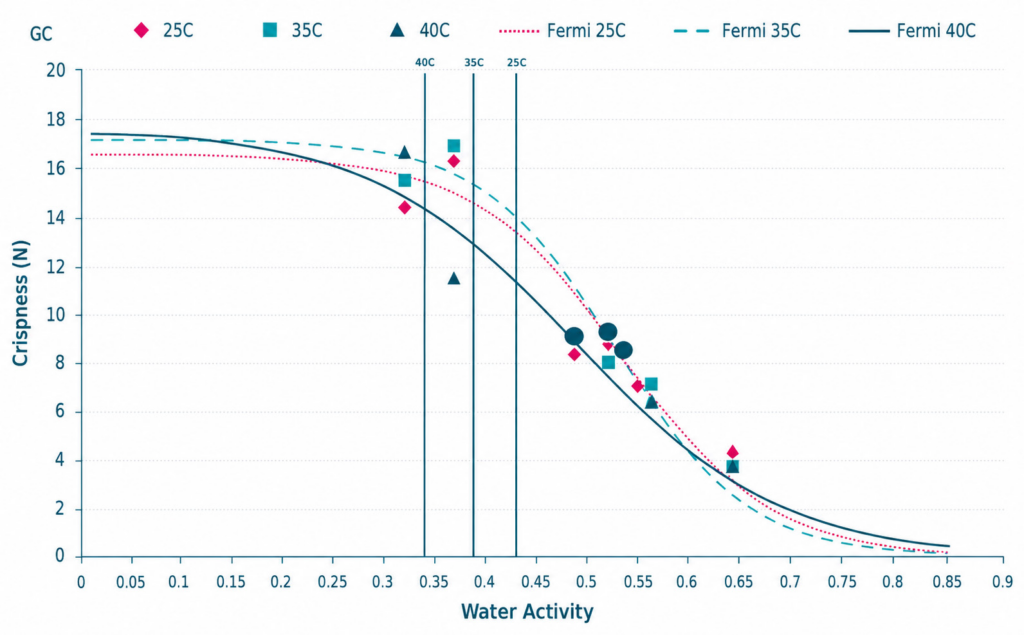
The best product target is therefore usually a range, not simply a maximum. For a dry kibble, the upper quality boundary may be determined by the aw at which crispness becomes unacceptable, while the lower boundary may be influenced by excessive hardness, oxidation, drying cost or yield. For a semi-moist treat, the upper boundary may additionally be determined by microbiological stability.
Sensory testing and instrumental texture measurements can be combined with controlled aw equilibration to identify a product-specific critical water activity. This turns statements such as “the kibble feels too soft” into a measurable product-development specification.
Multi-Texture Pet Foods and Moisture Migration
Some of the most interesting pet-food formulations intentionally combine components with very different textures: crunchy kibble with soft pieces, filled treats, simulated marrow bones or hard products containing moist inclusions.
These products create a moisture-migration challenge. Water does not move simply from the component with more moisture to the component with less moisture. It moves according to differences in chemical potential — effectively from higher water activity toward lower water activity — until the system approaches equilibrium.
If a soft component has significantly higher aw than the surrounding dry kibble, the dry component can gain water and soften while the moist component loses water and hardens.
The solution is not necessarily that every component must have exactly the same aw. In many products, perfect matching may compromise texture or formulation. Instead, R&D can reduce the aw gradient, adjust formulation, use barriers or coatings, alter geometry or model the rate of moisture migration so that the desired textures remain acceptable throughout the required shelf life.
This is where water activity provides something moisture content cannot: the direction and thermodynamic driving force for moisture movement.
Incoming Ingredients: Find the Problem Before It Reaches Final QC
One of the most practically useful concepts in the existing Novasina work is to move water activity testing upstream. Imagine a production line with established extrusion, oven or dryer settings. Those settings work because incoming ingredients normally arrive within an expected range of composition and moisture behavior. If a new ingredient lot arrives at a significantly different aw, the same process conditions may no longer produce the same final product.
If this variation is discovered only during final QC, the batch may already require rework or disposal. The existing Novasina article therefore proposes measuring water activity not only on the finished product but also on incoming ingredients and establishing acceptable aw ranges for materials that have a meaningful influence on the final process.
This creates a much more proactive process-control strategy. Incoming inspection can identify unusual ingredient lots before production begins. Process measurements can show how extrusion, cooking and drying are changing the product. Final QC confirms that the validated aw target has been reached. Packaging and shelf-life studies then demonstrate that the product remains within its acceptable range after production. Instead of asking why a finished batch failed, the manufacturer can begin identifying where the water activity changed.
Packaging Must Protect Against Both Moisture and Oxygen
Reaching the correct water activity at the end of the dryer is only useful if the product remains there. Dry pet food will tend to absorb moisture when exposed to an environment with higher equilibrium relative humidity. In humid climates, an inadequate moisture barrier can therefore move the product toward its critical aw during storage.
The key packaging parameter for this risk is WVTR — Water Vapor Transmission Rate.
But moisture is only one problem. For fat-rich kibble, lipid oxidation may require control of oxygen as well. That makes OTR — Oxygen Transmission Rate, headspace oxygen and technologies such as nitrogen flushing or oxygen scavengers relevant.
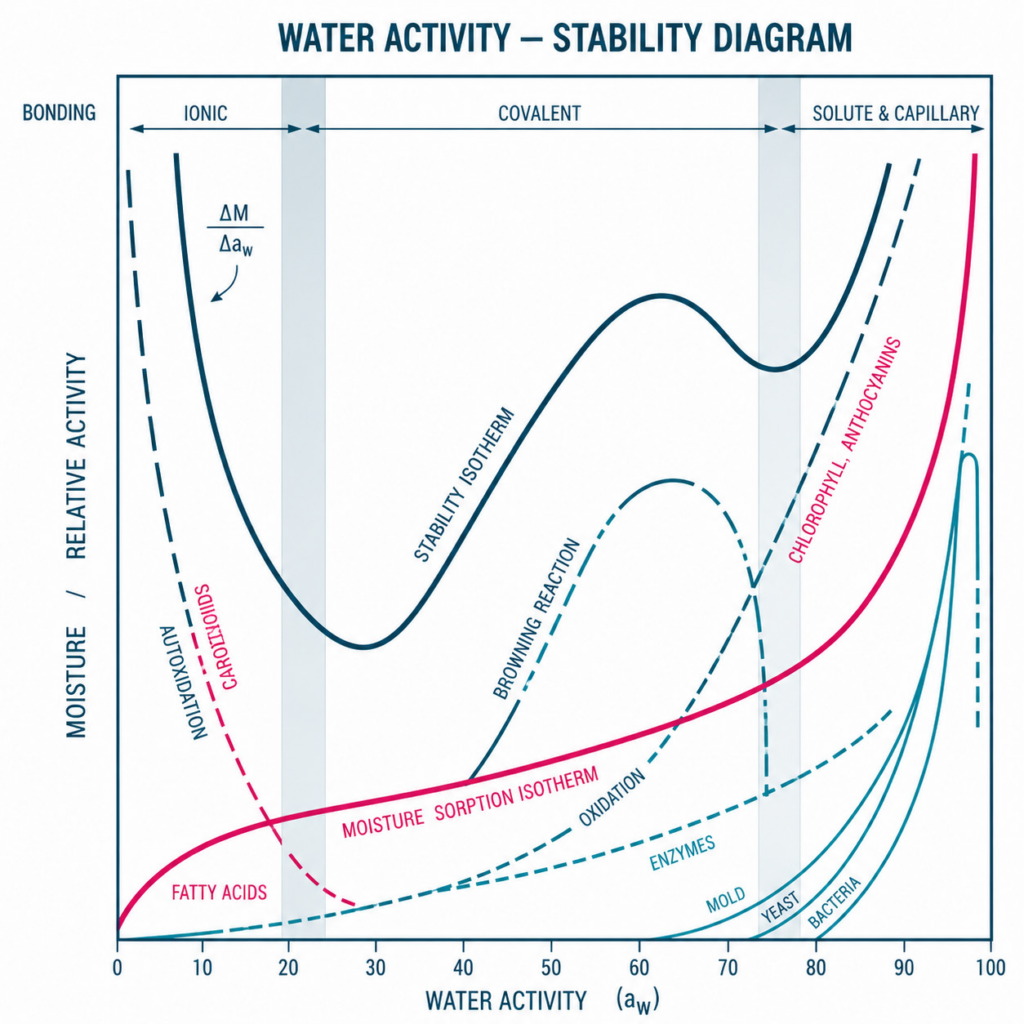
Figure 1. Water activity stability map showing the typically response of modes of failure to increasing water activity (by permission Ted Labuza).
A strong packaging specification should therefore be linked to the actual shelf-life failure mechanism. If the main risk is softening through moisture uptake, water-vapor protection is critical. If rancidity is the limiting factor, oxygen protection becomes equally important. In many dry pet foods, both need to be managed.
The same thinking should extend beyond the unopened package. Large pet-food bags can remain open in the consumer’s home for weeks, so reclosure, local humidity, package size and storage instructions can influence how rapidly the product changes after opening.
Do Not Over-Dry: Water Activity Can Also Protect Yield
Drying is often treated conservatively: if lower moisture improves stability, then drying slightly longer appears safer. But once the validated aw target has been achieved, additional drying can become economically counterproductive.
Pet food is sold by mass. Removing more water means removing sellable product weight. Additional drying also requires energy, consumes dryer capacity and can make kibble harder than intended. Consider a simplified example. A finished batch weighing 10,000 kg at 9% moisture contains 9,100 kg of dry solids. If those same dry solids are unnecessarily dried to 8% moisture, the final mass falls to approximately 9,891 kg.
That is roughly 109 kg less sellable product from the same dry solids, before considering the additional drying energy and capacity required. This does not mean that 9% moisture is the correct specification for any particular pet food. It simply illustrates the economic consequence of drying below the level actually required.
The correct sequence is: Determine the validated aw range first. Then identify how much moisture the specific formulation can safely retain at that aw. This is where moisture sorption isotherms can become powerful formulation and process-development tools.
Formulation Can Retain Moisture Without the Same Increase in aw
Drying is not the only way to reduce water activity. Solutes and humectants interact with water and can lower its chemical potential. Depending on the application and species, formulation tools may therefore allow manufacturers to retain more total moisture while maintaining the required aw.
FDA Guidance #245 explicitly discusses both formulation and drying as mechanisms for controlling aw in animal foods and notes examples such as salt and appropriate humectants, while also identifying species-specific restrictions such as the exclusion of propylene glycol in cat food.
For semi-moist pet foods and treats, this can be especially valuable because the manufacturer is balancing microbial stability against softness and palatability. The goal is not necessarily the driest possible product. It is the formulation that delivers the required safety and stability while retaining the texture, palatability and product mass the customer expects.
From R&D to the Finished Bag
The greatest value of water activity comes when it is used throughout the product lifecycle rather than only as a final pass/fail test. During R&D, aw can be used to identify critical microbial, chemical or physical limits and establish a target operating range. Procurement and incoming inspection can monitor ingredients whose variability influences processing. Production teams can use aw to understand extrusion and drying performance instead of relying only on time, temperature or moisture content. QA can confirm that finished batches meet the validated specification. Packaging developers can then design moisture and oxygen barriers around the actual shelf-life risks.
This turns water activity from a laboratory number into a common language between R&D, Quality, Production and Packaging. And that is the real opportunity.
Water Activity Measurement and ISO 18787
Water activity measurement is standardized internationally. ISO 18787:2017 — Foodstuffs — Determination of water activity explicitly covers both food for human consumption and animal feed.
For detailed guidance on sampling, temperature control and sample preparation, manufacturers can refer to the Novasina Water Activity Sample Preparation Guide.
The Key Takeaway
The most important question in pet-food moisture management is not:
“How much water does the product contain?”
It is:
“What can the water in this specific product do?”
For wet pet food, water activity can help describe conditions that support microbial growth. For semi-moist products, it helps balance microbiological stability against softness and palatability. For dry kibble, it helps explain moisture uptake, texture changes and chemical shelf-life problems. For multi-component products, it predicts the direction of moisture migration. During manufacturing, it can reveal ingredient and process variability before it turns into rework or waste. And once the correct target has been validated, it can help prevent unnecessary over-drying and loss of yield.
The correct water activity is therefore not one universal number. It is a product-specific operating range defined by the failure modes that matter most to safety, quality, shelf life and commercial performance. That is where water activity becomes more than another QC measurement. It becomes a tool for developing safer pet food, better palatability, more predictable shelf life and more efficient production.
Frequently Asked Questions About Water Activity in Pet Food
What is a safe water activity for pet food?
There is no universal aw specification that makes every pet food safe. FDA Guidance #245 generally considers 0.85 aw the cutoff below which bacterial pathogen growth is controlled, while foods below 0.60 aw are classified as low-moisture animal foods. The appropriate product specification also depends on formulation, pH, preservatives, processing, packaging and other controls.
What water activity should dry dog food or kibble have?
There is no universal optimum aw for all kibble formulations. Many dry products are produced below 0.60 aw to prevent microbial proliferation, but the ideal target should also consider texture, oxidation, palatability, formulation and packaging. In Novasina’s original survey, the dog and cat kibbles tested measured approximately 0.49 and 0.46 aw respectively, but these values are examples rather than universal specifications.
Does low water activity kill Salmonella in pet food?
No. Low aw can prevent Salmonella from multiplying but does not necessarily eliminate viable cells already present. Appropriate lethality, sanitation and prevention of post-process contamination remain essential components of pet-food safety.
Why can pet food mold even when moisture content is within specification?
Because moisture content and water activity are not the same measurement. Formulation and ingredient changes can alter the relationship between total moisture and aw. A product can therefore remain inside a historical moisture specification while moving into a water activity range that supports undesirable microbial or physical changes.
Why does dry kibble become rancid even though its water activity is low?
Low water activity prevents microbial proliferation but does not stop all chemical reactions. Dry pet food frequently contains significant lipid content or surface-applied fats, and oxidation can generate rancid odors and flavors. Oxygen exposure, temperature, antioxidants, packaging and aw all influence the final shelf-life behavior.
Why does kibble become soft during storage?
When dry kibble is exposed to an environment or another component with higher water activity, it tends to absorb water. As water plasticizes the product matrix, crispness can eventually decrease. The exact critical aw for texture loss is product-specific.
Where should water activity be measured in a pet food plant?
Finished-product QC is an important point, but water activity can also provide value during incoming ingredient inspection, process development, after extrusion or drying, packaging studies and shelf-life validation. Measuring earlier in the process can identify variability before an entire batch reaches final QC.
Read the scientific application note by Dr. Brady Carter, global water activity expert, for a detailed look at the underlying science and practical implications.
Scientific and Regulatory References
Katz, E.E. & Labuza, T.P. (1981). Effect of water activity on the sensory crispness and mechanical deformation of snack food products. Journal of Food Science.
U.S. Food and Drug Administration. Guidance for Industry #245: Hazard Analysis and Risk-Based Preventive Controls for Food for Animals.
U.S. Food and Drug Administration. FSMA Final Rule for Preventive Controls for Animal Food, 21 CFR Part 507.
ISO 18787:2017. Foodstuffs — Determination of water activity.
Scott, W.J. (1957). Water relations of food spoilage microorganisms. Advances in Food Research, 7, 83–127.
Beuchat, L.R. (1983). Influence of water activity on growth, metabolic activities and survival of yeasts and molds. Journal of Food Protection, 46(2), 135–141.
Lowe, J.A. & Kershaw, S.J. (1995). Water activity-moisture content relationship as a predictive indicator for control of spoilage in commercial pet diet components. Animal Feed Science and Technology, 56(3–4), 187–194.
Carter, B.P., Syamaladevi, R.M., Galloway, M.T., Campbell, G.S. & Sablani, S.S. (2017). A Hygrothermal Time Model to Predict Shelf Life of Infant Formula.
Get in touch and learn more about your specific application and its possibilities! sales@novasina.ch


