
WATER ACTIVITY SAMPLE PREPARATION: HOW TO GET RELIABLE AND REPRODUCIBLE RESULTS
FAQ
How should a sample be prepared for water activity testing?
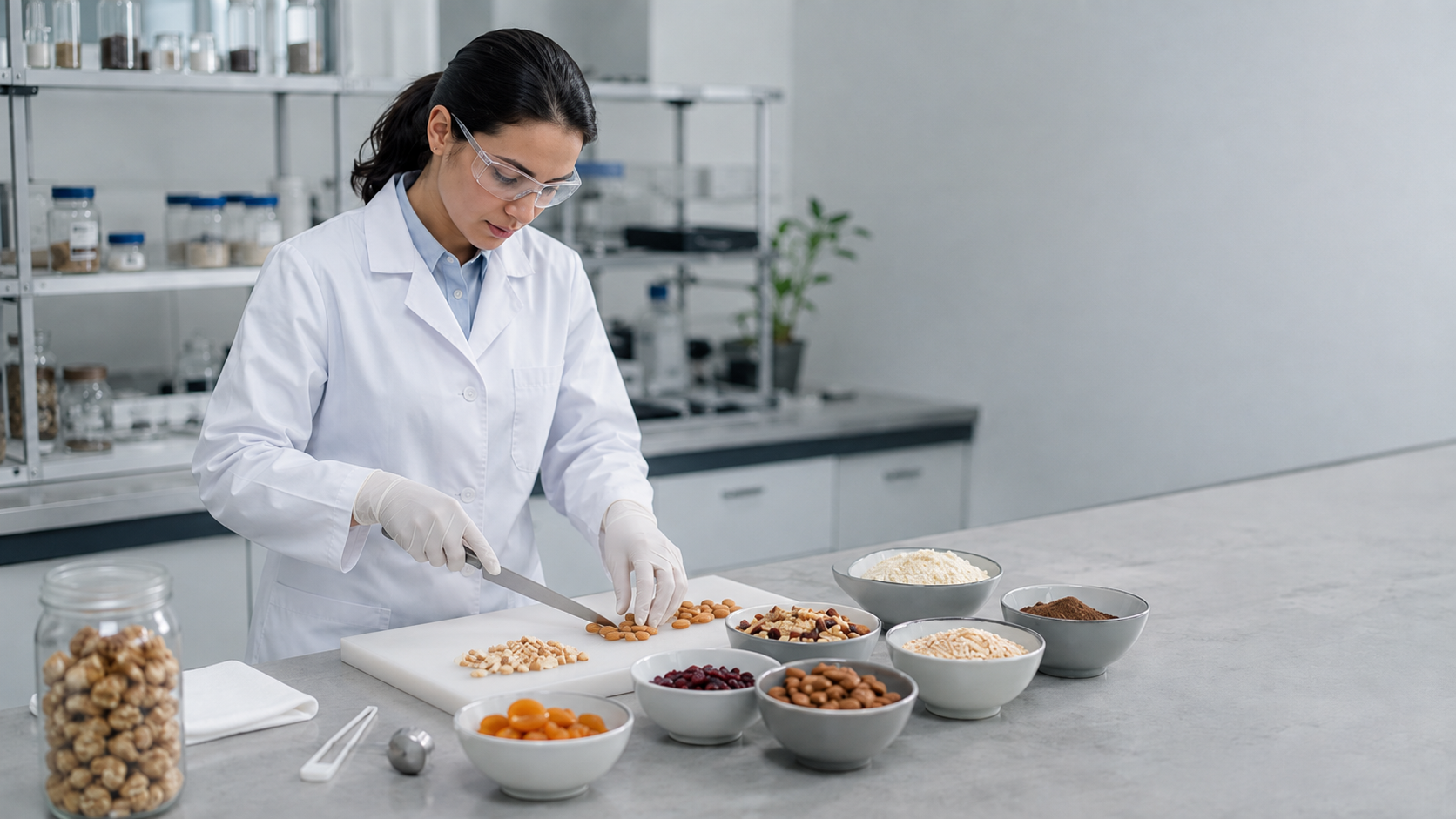
The sample should be representative of the product and prepared consistently for every measurement. Depending on the product, this can include breaking or crushing solid samples, creating a homogeneous portion or ensuring that multi-component products contain a representative ratio of each component.
How much sample is needed for a water activity measurement?
Use enough sample to provide a representative test portion and, where practical, cover the bottom of the sample cup. With Novasina sample cups, the product should not be filled above the middle ring, as overfilling can contaminate the measurement chamber.
Should food samples be ground before measuring water activity?
Not always. Grinding or breaking a sample can be useful when the objective is to determine an average or internal water activity or to improve homogeneity. However, the preparation method should always reflect what the measurement is intended to represent. Pay attention: Grinding can heat up and change the sample and as such change the water activity of the sample.
Why do water activity measurements sometimes take longer?
Measurement time depends on the sample. High-sugar, fat-coated, solid or multi-component products can require more time to equilibrate. A larger exposed sample surface can often reduce measurement time, but the sample should never be altered solely for speed if this changes what the measurement represents.
Why should fresh sample cups be used?
Fresh sample cups reduce the risk of cross-contamination, residual moisture and detergent contamination. They also make the measurement procedure easier to standardize, which is particularly important for QC, validation and regulated environments.
How can I improve repeatability in water activity testing?
Use the same sampling and preparation procedure for every measurement. Standardize sample selection, preparation, component ratios, cup filling, handling and stability settings. Better control of sample preparation generally results in more comparable water activity data.
How to Get Reliable and Reproducible Results
Even a highly precise water activity meter can only measure what is placed inside the measurement chamber. If the sample is not representative, has been exposed to ambient air, is prepared differently from one measurement to the next or has not reached equilibrium, the resulting water activity value may not accurately reflect the product.
Fortunately, good water activity sample preparation does not need to be complicated. A few simple rules can significantly improve repeatability and reproducibility.
Start with a representative sample
The first question should always be: What should this measurement represent?
A water activity meter normally tests only a small amount of material, while that sample may represent an entire production batch. The sample therefore needs to reflect the product as closely as possible.
This is particularly important for heterogeneous products such as dried fruits, nuts, cereals, pet foods or snack mixes. Individual pieces can have different water activities.
For routine QC, define where samples are taken, how they are prepared and how much material is tested. Then follow the same procedure every time. Consistency in sampling is one of the easiest ways to improve repeatability.
Prepare the sample according to what you want to measure
Not every sample should be treated the same way. Powders can normally be measured directly. Larger solid or coated products may need to be broken or crushed when the objective is to measure the internal or average water activity.
For multi-component products such as granola, trail mix or pet food, include a representative amount of each component. Ideally, the proportions in the sample cup should reflect the mass ratio of the finished product.
If you are troubleshooting moisture migration between individual components, however, measure the components separately as well.
The important principle is simple: Prepare the sample so that it represents the question you are trying to answer — and prepare it the same way every time.
Protect the sample from ambient air
Once a sample has been collected, measure it as soon as possible. A product left uncovered can exchange moisture with the surrounding air. Depending on the product and laboratory conditions, this can change its water activity before the measurement even starts.
If the sample cannot be measured immediately, keep it in a properly sealed container until testing. This is especially important for low water activity products, powders and samples measured in environments with high or changing relative humidity.
Use clean tools and fresh sample cups
Sample cups, tools and gloves should be clean and dry. Residues from previous products, water from washing or traces of detergent can introduce unnecessary measurement variability. For this reason, Novasina recommends using fresh sample cups, particularly for quality control, validation and regulated environments.
Fresh cups help avoid cross-contamination and remove one more variable from the measurement process. It is a simple step, but an important one when reproducible water activity results matter.
Fill the sample cup correctly
You do not need to fill the entire sample cup. Use enough material to create a representative sample and, where possible, cover the bottom of the cup. With Novasina sample cups, the product should not be filled above the middle ring.
Overfilling does not improve the measurement and increases the risk of contaminating the measurement chamber.
Large products such as nuts, tablets or confectionery pieces may not completely cover the bottom of the cup. That is normally fine. What matters more is that the same sample quantity and preparation method are used consistently.
More surface area can mean faster measurements
Increasing the exposed surface area can help some samples reach equilibrium faster. For example, breaking a large solid product into smaller representative pieces can shorten measurement time because moisture can exchange more easily with the air in the measurement chamber.
However, do not grind every sample simply to make the measurement faster. And pay attention on grinding, because sample preparation such as grinding can heat up the sample and influence the water activity of the sample. So make sure avoid heating up a sample.
And most important: A representative sample is more important than the fastest possible measurement.
Let the sample reach equilibrium
Water activity is an equilibrium measurement. After the sample cup is placed inside the instrument, the product and the air in the measurement chamber need time to reach vapor equilibrium. Only then does the measurement represent the true water activity of the sample.
Some samples equilibrate quickly. Others take longer.
High-sugar products, fat-coated products, dense solids and multi-component samples can require more time. The correct stability setting should therefore be selected for the product and then used consistently.
Do not change the endpoint simply because one measurement is taking longer than expected. The objective is not the shortest possible measurement. The objective is a reliable equilibrium result.
Keep measurement conditions consistent
When comparing water activity results between batches, operators or laboratories, measurement conditions should also remain consistent.
Sample temperature is particularly important. Avoid measuring products directly after heating, cooling or refrigeration unless this is part of a specifically defined measurement procedure.
For routine QC, samples should be measured under consistent conditions so that changes in the result reflect changes in the product rather than changes in the measurement procedure.
When results are inconsistent, check the sample first
If two water activity measurements differ more than expected, the instrument is not necessarily the cause. Before investigating the sensor, check how the samples were handled.
| If you see… | Check… |
|---|---|
| Different results between operators | Sampling and preparation procedure |
| water activity increases during repeated measurements | Sample equilibration or exposure to ambient air |
| Large variation within one batch | Product heterogeneity and sampling location |
| Unexpectedly long measurement time | Coating, high sugar/fat content or low exposed surface area |
| Unstable results | Sample temperature, preparation and equilibrium |
| Results differ between laboratories | Sampling SOP, temperature, preparation and instrument settings |
Sometimes variation is not measurement error. Sometimes the variability is actually in the product — and discovering it is exactly what water activity testing is supposed to do.
The simple rule for good water activity sample preparation
Reliable water activity testing does not require complicated sample preparation. Use a representative sample. Prepare it consistently. Protect it from ambient moisture. Use clean tools and fresh sample cups. Fill the cup correctly. Increase the surface area when appropriate and allow the sample to reach equilibrium.
If those steps are standardized, water activity measurements become much easier to compare between samples, operators and production batches. And that is what turns a water activity value into reliable quality-control data.
Want a quick reference for your laboratory?
Download the Novasina Sample Preparation Guide for a practical overview of sample handling, homogenization, sample-cup filling and equilibrium measurement.


