
WATER ACTIVITY IN DRIED FRUITS: SAFETY, TEXTURE & SHELF LIFE
Dried fruit is simple to make. Producing it consistently is not.
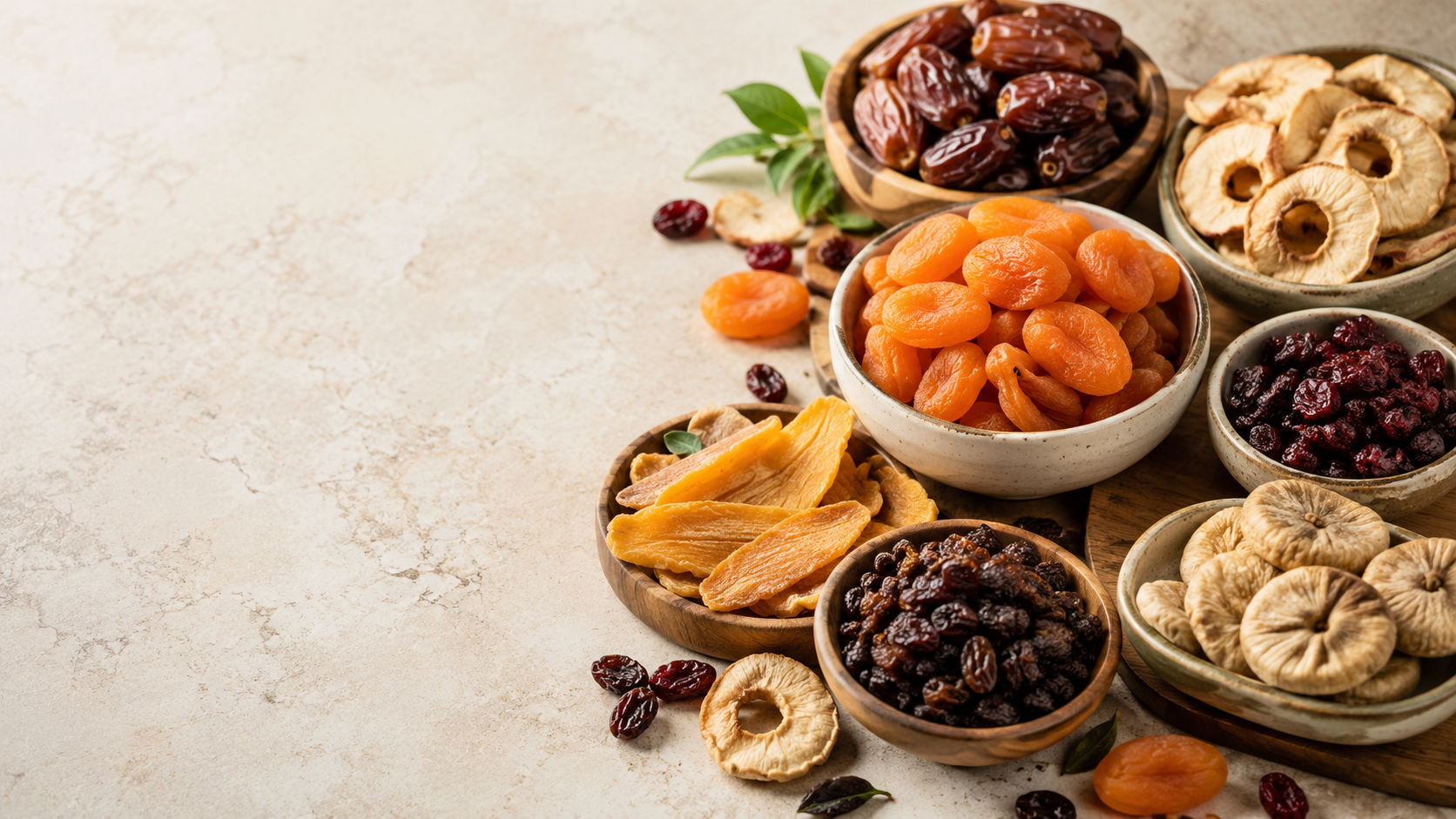
Drying fruit is one of the oldest preservation methods in the world. Remove enough available water and microbial growth becomes increasingly restricted, allowing products such as raisins, dates, figs, apricots, mangoes and cranberries to remain stable for months rather than days. What sounds straightforward becomes considerably more difficult once a manufacturer has to deliver the same safety, softness, appearance and shelf life from batch to batch.
Fruit is a biological raw material. Sugar content, maturity, variety, growing season, pretreatment and drying conditions all influence the way water interacts with the product. Consequently, the same moisture content does not necessarily produce the same water activity, and a moisture-content specification alone may not tell you whether a batch is microbiologically stable or whether its texture will remain acceptable during storage. Sorption studies on raisins, figs and apricots clearly demonstrate that the relationship between moisture content and water activity is product- and temperature-dependent rather than fixed. [1]
This distinction is fundamental. Moisture content tells you how much water is present. Water activity tells you how energetically available that water is. It is water activity, rather than the total amount of water, that directly determines whether water is available to support microbial growth and that helps describe the driving force for many physical and chemical changes. [2]
For a dried-fruit manufacturer, the useful question is therefore not simply, “How dry is my fruit?” The better question is: “Is the water activity of this product where it needs to be for safety, texture and shelf life — and can my process keep it there consistently?”
Why 0.85 aw is not a dried-fruit quality specification
The value 0.85 aw appears frequently in discussions about food safety. There is good reason for that. The FDA uses 0.85 aw as an important regulatory threshold in the context of water-activity-controlled foods because growth of major foodborne bacterial pathogens is increasingly restricted below this region. [2][3]
However, treating 0.85 aw as the target for dried fruit would be a serious oversimplification.
Dried fruits are particularly relevant to xerophilic molds and osmophilic yeasts, organisms adapted to environments with very limited available water. Some specialized fungi and yeasts are capable of growth at water activities close to approximately 0.60–0.65 under favorable conditions. [4] A review specifically addressing dried foods also emphasizes that low-water-activity foods are not sterile and that inappropriate drying, contamination or subsequent moisture uptake can still result in spoilage and other microbiological concerns. [5]
This means that a dried fruit can be comfortably below the bacterial-growth region and still experience mold, yeast fermentation or quality deterioration. That is why Novasina recommends thinking in terms of an application-specific operating window rather than a generic maximum limit.
A dried mango intended to be soft and chewy may require a different target from a raisin used as a bakery inclusion. A date intended for direct consumption can have different requirements from finely diced fruit incorporated into breakfast cereal. The relevant specification depends on what is most likely to make the product fail.
Start with the failure mode, not with the number
Before setting an aw specification, define what you are actually trying to control. For some dried fruits the primary concern is microbial stability. For others it is hardness, stickiness, sugar crystallization, color change or moisture migration into another ingredient.
This sounds like a small distinction, but it completely changes how water activity should be used.
Suppose a manufacturer specifies aw ≤ 0.60 purely because that number has historically been used in production. If the product is already microbiologically stable at the intended conditions but becomes undesirably hard when processed substantially below the specification, drying further has created no additional consumer value. It has simply removed more water, consumed more energy and reduced final product weight.
Conversely, increasing aw to maximize yield without understanding the microbial and physical consequences can shorten shelf life dramatically.
The objective should therefore be to find the highest practical water activity that still meets all relevant safety, quality and shelf-life requirements, while maintaining sufficient manufacturing margin to account for normal process variability. That is a much more useful way to formulate a specification than choosing a maximum number in isolation.
The influence of water activity on fruit texture is not theoretical. Research on Thompson seedless raisins found substantial changes in their mechanical behavior as aw changed. At very low aw, raisins behaved increasingly like brittle materials. As water activity increased, water acted as a plasticizer, changing the viscoelastic behavior of the fruit. At high aw, the skin became weaker and deformation increased. [6]
The texture of dried fruit can change dramatically with water activity
This explains something that dried-fruit manufacturers experience every day: the same fruit can move from hard to pleasantly chewy to excessively soft as its water activity changes.
For QC, that means sensory texture and aw should not live in separate worlds. If complaints about hardness increase while the microbiological data remain excellent, the first reaction should not automatically be to extend drying. In fact, the process may already be drying too far.
A useful development project is to condition the product to several water-activity levels, conduct structured sensory or texture testing and then determine the range where the desired eating experience overlaps with microbiological and chemical stability.
Once that window is known, aw becomes a manufacturing target, rather than merely a final laboratory result.
Don’t measure only the finished package — map the process
One of the biggest missed opportunities in water activity testing is measuring a single finished-product sample and using that number only for batch release.
That tells you whether the sample passed. It tells you very little about why it passed or failed.
For a new dried-fruit process, Novasina would recommend building a simple aw profile through production. Measure representative incoming material, then measure after the major drying step, after any conditioning or equalization stage, immediately before packaging and again during storage validation.
This process map often reveals more than weeks of troubleshooting.
If incoming fruit varies strongly in aw, the dryer is being asked to compensate for variable raw material. If material leaving the dryer shows substantial variability, airflow, loading, piece size or residence time may need investigation. If aw changes significantly between the end of drying and the next morning, internal moisture redistribution or incomplete equilibration may be involved rather than an unstable instrument. If aw is correct at packaging but increases later, attention should shift toward packaging, storage humidity or seal integrity.
The measurement has now changed from a pass/fail test into a diagnostic tool.
Conditioning after drying is easily underestimated
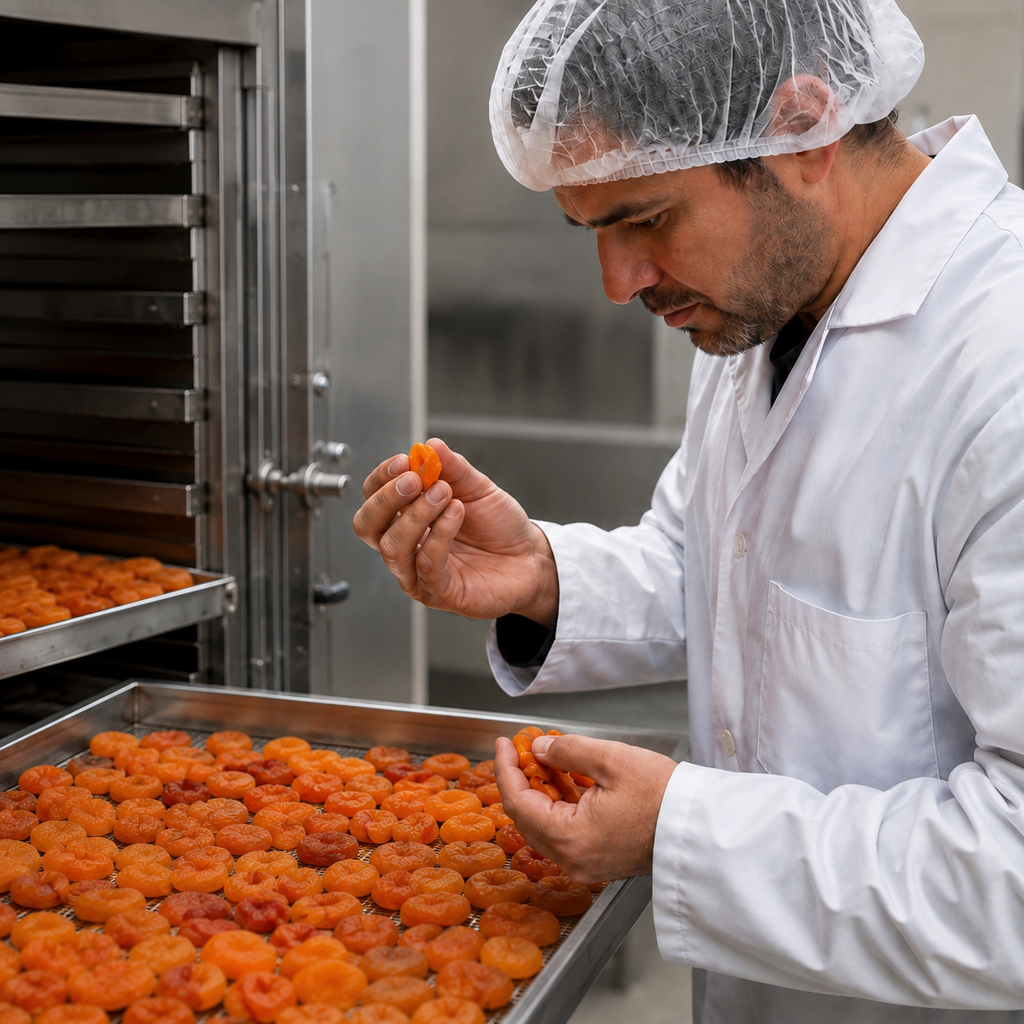
Fruit is not necessarily uniform internally when it leaves a dryer. The surface and interior can have different moisture conditions, particularly after relatively aggressive drying.
Water then redistributes within the product as the system moves toward equilibrium. In heterogeneous food systems, water transport continues until differences in chemical potential are reduced; work on mixed food systems such as dough and raisins illustrates how moisture distribution is governed by water-activity relationships rather than simply by moisture percentage. [7]
This has an important practical consequence: Imagine that raisins measure 0.51 aw immediately after drying but 0.57 aw after a defined conditioning period. It would be tempting to conclude that six points of aw have somehow entered the package. That is not necessarily the case. The first measurement may simply not have represented the final equilibrated condition of the entire fruit.
For this reason, a validated measurement SOP should define where the sample is taken, how it is prepared, when it is measured relative to processing and at what temperature. Without those controls, operators can spend hours adjusting a dryer in response to sampling variation rather than actual process variation.
Sampling can matter as much as instrument accuracy
Natural dried fruits are heterogeneous. One apricot half is not identical to the next, and a handful of raisins does not necessarily represent a 500-kilogram lot.
If a lot contains ten reasonably stable pieces and a small fraction of unusually wet pieces, calculating one convenient average can conceal the material most likely to cause problems.
The objective of sampling should therefore be to understand the distribution of aw, particularly during process development and when troubleshooting complaints. Instead of immediately combining everything into one homogenized sample, it can be more informative to test multiple subsamples from different positions in the lot, dryer or package.
For example, consider five measurements:
0.53 – 0.54 – 0.55 – 0.55 – 0.67 aw
The average is approximately 0.57 aw. That average looks reassuring. The distribution does not.
The 0.67 aw result is telling the process engineer something important. Perhaps one large fruit dried differently. Perhaps airflow is uneven. Perhaps products entered the dryer with different initial conditions. Perhaps one portion of the batch reabsorbed moisture.
A mature QC program does not simply ask “What was the average aw?” It also asks “How variable is our aw, and where is that variability coming from?”
Measure at a controlled temperature if you want comparable data
Water activity is thermodynamic and temperature matters. This becomes especially important when QC teams compare data between factories, suppliers, production days or laboratories.
Novasina therefore recommends that comparative measurements be performed at a standardized temperature. The LabMaster-aw neo, for example, provides full temperature control from 0 to 60°C and a published accuracy of ±0.003 aw. Novasina’s operating guidance specifically stresses that measurements used for batch-to-batch comparison should be recorded at the same temperature. [8]
This is not laboratory perfectionism. If your upper specification is close to the normal production range, measurement variability caused by uncontrolled sample temperature can lead to incorrect conclusions about process capability.
For routine dried-fruit QC where portability matters more than full temperature control, other measurement approaches may be appropriate. The important point is that the measurement method must match the decision being made.
The package is part of the water-activity system
Reaching the correct aw at the end of production is only half of the job. Dried fruit is hygroscopic. If the product is stored in an environment with sufficient humidity and the packaging permits water-vapor transmission, it can adsorb moisture. Its water activity rises, which can change texture and eventually increase the risk of microbial spoilage.
Temperature also matters because dried fruits have temperature-dependent sorption behavior. Studies on dried apricots, figs and raisins demonstrate that the relationship between equilibrium moisture content and aw changes with temperature, particularly in high-sugar systems. [1]
This means that shelf-life validation should not stop with a day-zero aw measurement. A much more useful program follows aw over time under realistic or accelerated storage conditions. If the product begins at the correct aw but drifts upward, the question becomes whether the package has an adequate moisture barrier for the intended climate and shelf life.
The best dryer in the world cannot compensate for packaging that allows the product to move out of its stability window during distribution.
Moisture migration becomes critical when dried fruit is used as an ingredient
The challenge becomes even more interesting when dried fruit is combined with another food. Consider raisins in cereal, dried cranberries in granola, fruit pieces in chocolate, dates in a protein bar or dried mango in a nut mixture. Moisture does not migrate simply from the ingredient containing the largest percentage of water to the ingredient containing less.
The driving force is the difference in water activity.
Water moves from the component with higher aw toward the component with lower aw until the system approaches equilibrium. Experimental work on dough-raisin systems has demonstrated this behavior, including discontinuities in moisture content between the components despite their tendency toward water-activity equilibrium. [7]
This is why two ingredients can have very different moisture contents and coexist successfully, while two apparently similar ingredients can destroy each other’s texture.
If chewy fruit at 0.62 aw is mixed with a very crisp cereal component at 0.25 aw, the cereal will tend to gain water. Over time it may become soft while the fruit becomes firmer. The manufacturer then sees a shelf-life problem that cannot be solved simply by checking the moisture content of the final mixture.
The practical approach is to measure the individual components before combining them and reduce the aw gradient through formulation, processing, barriers or other product-design strategies. That is water activity being used in product development rather than only in QC.
When a dried-fruit product fails, let the pattern guide the investigation
If mold appears only in isolated packages, investigate product heterogeneity, local high-aw pieces, package integrity and sampling before changing the entire drying process. If fruit becomes too hard, compare complaint samples with the normal aw distribution and determine whether over-drying is occurring. If the product becomes sticky during storage, follow aw over time and investigate packaging permeability and storage humidity. If a fruit inclusion causes a cereal or biscuit to soften, measure the components separately and examine the aw gradient before reformulating the entire product.
Likewise, if drying time varies inexplicably from lot to lot, start measuring incoming aw rather than assuming that every batch enters the dryer in the same condition. And if the finished product consistently sits far below the validated upper limit, determine whether that margin is genuinely needed or whether it represents unnecessary energy consumption and yield loss.
The correct aw number is useful, but understanding why that number is correct is much more valuable.
From a laboratory number to process control
For Novasina, the goal of water activity measurement is not simply to create another specification on a certificate of analysis.
The objective is to understand the product well enough that water activity can be used to control raw-material variability, establish the correct drying endpoint, protect texture, manage microbial risk, select packaging, investigate failures and predict how the product will behave during storage.
That is also why the ideal specification should rarely be borrowed blindly from another dried fruit. A raisin, fig, date and mango have different compositions, structures and intended sensory properties.
The strongest approach is to determine your own stability window, validate it and then make the production process capable of consistently delivering product inside it.
As the Novasina water-activity approach emphasizes across food applications, the most useful specification is the one based on the most likely mode of product failure. [9]
Once that is understood, water activity stops being an abstract laboratory measurement. It becomes one of the most practical process-control tools available to a dried-fruit manufacturer.
Sources — Dried Fruits
[1] Ayranci, E., Ayranci, G. & Dogantan, Z. Moisture Sorption Isotherms of Dried Apricot, Fig and Raisin at 20°C and 36°C. Journal of Food Science, 1990.
[2] U.S. FDA. Water Activity (aw) in Foods. Definition, sorption behavior and regulatory relevance of water activity.
[3] U.S. FDA. Hazard Analysis and Risk-Based Preventive Controls for Human Food. Notes the importance of water-activity control specifically for dried-fruit products.
[4] Stevenson et al. Is there a common water-activity limit for the three domains of life? Research discussing growth of extreme xerophilic fungi at very low aw.
[5] Bourdoux et al. / review: The microbiological quality of various foods dried by applying different drying methods. Discussion of microbial stability and contamination risks in dried foods.
[6] Lewicki, P.P. & Wolf, W. Rheological properties of raisins: Part II. Effect of water activity. Journal of Food Engineering, 1995.
[7] Diffusion and equilibrium of water in dough/raisin mixtures. Journal of Food Engineering, 1995. Demonstrates water transport and equilibrium behavior in multicomponent food systems.
[8] Novasina. LabMaster-aw neo — measurement and temperature guidance. Novasina specifies controlled temperature for comparable measurements and a published accuracy of ±0.003 aw.
[9] Novasina / Dr. Brady Carter. Application guidance on defining the ideal water-activity specification based on the likely mode of product failure.


