
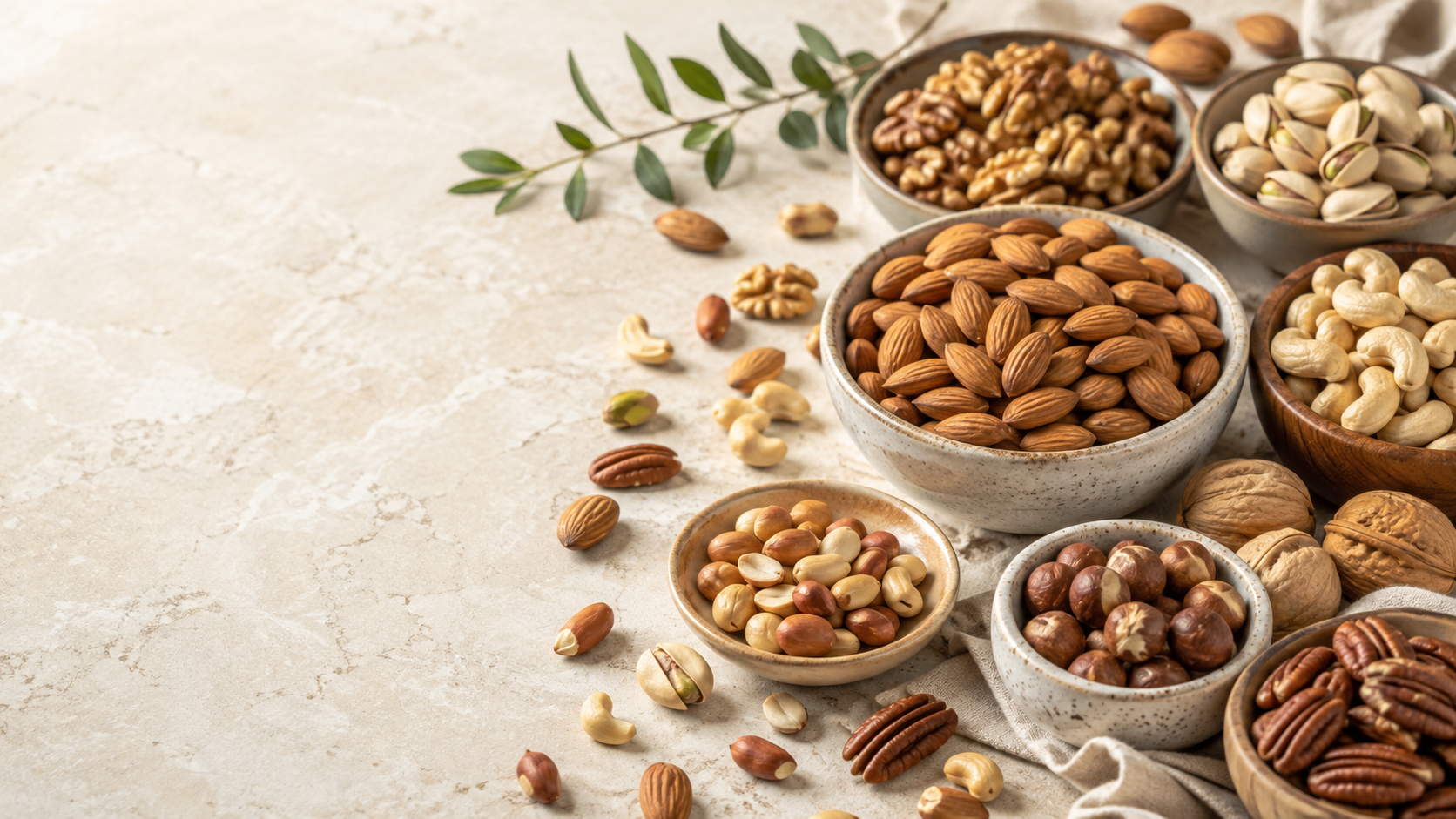
WATER ACTIVITY IN NUTS: CRUNCH, RANCIDITY & SHELF LIFE
For nuts, “drier is better” is not a good water-activity strategy
At first sight, moisture control in nuts seems easy. Nuts are low-moisture foods. Keep them dry and they should remain crisp, stable and safe. In reality, nuts are one of the best examples of why water activity management requires more than simply pushing a product toward the lowest possible value.
If water activity becomes too high, nuts can lose their characteristic crunch, support undesirable physical or chemical changes and eventually become vulnerable to fungal growth. Yet drying them more and more is not necessarily the answer. Nuts contain substantial amounts of unsaturated lipids, and lipid oxidation — the chemistry behind rancid flavors and aromas — does not always decrease continuously as aw approaches zero. Depending on the nut, processing history and storage conditions, very low water activity can also be unfavorable for oxidative stability. [1][2]
The ideal water activity of a nut is a stability window, not a race toward zero. Finding that window requires the manufacturer to consider microbial stability, sensory texture, lipid oxidation, processing conditions, packaging and the variability of the raw material together.
Moisture content and water activity answer different questions
Nuts are commonly controlled using moisture content, and moisture remains a useful production parameter. But moisture content and water activity are not interchangeable.
Moisture content describes the total amount of water present. Water activity describes its thermodynamic availability and is linked to the equilibrium relative humidity surrounding the product. Different matrices can therefore contain different amounts of total water while having the same water activity. [3]
For nuts, this matters because microbial growth, water exchange with the environment and many quality mechanisms respond more directly to “available” water than to the percentage of total water.
The Almond Board of California, for example, explicitly distinguishes moisture content from water activity when discussing almond stability and notes that almonds stored under cool, dry conditions commonly occur in a relatively low-aw region. [4]
So if two almond lots both meet the same moisture specification but perform differently during storage, aw can reveal differences that moisture percentage alone may not explain.
Microbiologically stable does not mean sterile
This distinction is particularly important for nuts. Low water activity inhibits the growth of most bacterial pathogens, which is one of the reasons nuts can be shelf stable for long periods. The FDA similarly identifies almonds, walnuts, pistachios, pecans, macadamias and peanuts as examples of commodities normally having aw below 0.85. [5] But low aw does not mean that pathogens cannot survive.
Salmonella is especially important in low-moisture foods. Studies have demonstrated long-term survival of Salmonella on almonds and other nuts even at water activities where active bacterial growth is prevented. Research on almonds conditioned to different aw values found that Salmonella survival remained significant and, importantly, that lower-aw almonds could require more severe dry-heat conditions for equivalent pathogen reduction. [6]
That distinction should be made very clearly in any professional water-activity program:
Water activity can prevent microbial proliferation. It is not, by itself, a kill step.
A nut manufacturer therefore should not use a low aw test as evidence that a contaminated lot has somehow been rendered microbiologically safe. Supplier controls, validated pasteurization or kill steps, hygienic design and prevention of recontamination remain essential.
Water activity performs a different job: it helps maintain the product in a condition where microbial growth cannot occur and contributes valuable information for process validation and stability management.
Crunch has a water-activity dimension
Consumers rarely describe a nut by its water activity. They describe it as crisp, crunchy, stale, soft or chewy. Those sensory attributes are exactly why water activity matters.
When a dry nut is exposed to a humid environment, it adsorbs water until it approaches equilibrium with that environment. As its aw increases, its physical properties can change, eventually causing loss of the crisp texture expected by the consumer.
This means that an aw specification should not be based only on microbial limits. The sensory failure point may occur substantially earlier.
A practical development program is therefore to condition representative product at several aw levels and combine instrumental or sensory texture testing with aw measurement. The result is far more valuable than simply establishing the lowest achievable value.
You can identify the point where the product begins to lose acceptable crunch and use that as one boundary of your stability window.
The same principle applies when comparing raw, roasted, blanched, chopped, coated or seasoned nuts. Processing changes structure and composition, which can change the product’s behavior during storage. An aw target validated for raw whole almonds should not automatically be transferred to roasted almond pieces, flavored cashews or nut-containing confectionery.
Rancidity is where the idea that “drier is always better” breaks down
Microbial reasoning encourages us to think that decreasing water activity is always beneficial. Lipid chemistry teaches a more nuanced lesson.
Nuts contain large quantities of fat, and oxidative deterioration is often one of the primary factors determining their shelf life. Oxygen, temperature, fatty-acid composition, processing and packaging all influence oxidation, but water activity also plays a role.
For almonds, the Almond Board reports that lipid oxidation is typically lowest at approximately 0.25–0.35 aw, with oxidation increasing above or below this range. [1] That should not be turned into a universal specification for every almond product, but it illustrates an important principle: there can be an optimum region rather than a simple “the lower, the better” relationship.
Studies with other nuts demonstrate the same need for product-specific validation. Research on high-oleic peanuts stored at different water activities found different oxidation rates across the aw conditions tested, with both very dry and higher-aw conditions influencing oxidative and sensory stability. [2] In macadamia nuts, another study found minimum lipid oxidation under the tested conditions around 0.436 aw at 35°C, with that region also associated with favorable stability of texture and color. [7] These numbers are not interchangeable.
A peanut is not a macadamia, a macadamia is not an almond, and a roasted nut is not the same matrix as its raw equivalent. The real lesson from the science is this: Every nut product has a stability landscape, and water activity is one of the variables defining it.
Set an aw window, not just an upper limit
Suppose a manufacturer establishes:
Specification: aw < 0.50
Production delivers most batches around 0.30 aw. From a simple compliance perspective, everything looks excellent.
But what if the best combination of crunch and oxidative stability for that specific product actually occurs around 0.35–0.40 aw? If so, pushing every batch unnecessarily toward 0.25 could create additional drying cost without increasing product stability — and could potentially move the product toward less favorable oxidative conditions.
This is why an advanced aw specification should ideally contain a target operating range, not merely an upper safety limit.
The upper side of that range can be determined by the first relevant failure mode: unacceptable texture change, fungal risk, accelerated chemical deterioration or another product-specific issue. The lower side can be determined by undesirable processing effects, oxidation behavior, yield considerations or unnecessarily aggressive drying.
Then normal production should target the center of the validated range with sufficient margin for process variability. That approach gives operators something actionable. “Below 0.50” only tells them when the product is too wet. “Target 0.35–0.40, validated for our formulation and package” tells them where to run the process.
Measure before and after roasting if you want to understand your process
Roasting is a good example of why water activity belongs on the production floor as well as in the laboratory. A manufacturer can measure incoming nuts to understand raw-material variability, measure immediately after roasting to evaluate process impact, and then measure after a defined cooling or conditioning period before packaging.
If every incoming batch begins at a different aw, a fixed roasting time may produce different final conditions. If product is extremely low directly after roasting but rises after equilibration, the immediate result may not represent the final packaged product. If aw is stable after processing but increases later, the source of the problem is more likely downstream.
Rather than asking only “Did this batch pass?”, the data allow the team to ask:
“At which point did this batch become different?”
That question dramatically shortens root-cause investigations. Trend the results over time and additional patterns become visible. A particular supplier may deliver more variable material. One roasting line may consistently produce a wider distribution. Seasonal changes may affect raw-material conditions. A new seasoning may change the relationship between aw and moisture content. Water activity then becomes part of statistical process understanding, not simply an isolated QC result.
Sampling is particularly important with nuts
A nut lot is not necessarily homogeneous. Size, cultivar, harvest conditions, shelling, drying, storage history and processing can all introduce variability. Measurements from a single kernel or a conveniently collected handful therefore need to be interpreted in the context of the sampling plan.
During routine production, a validated composite approach may be appropriate. During troubleshooting, however, averaging everything can hide useful information.
If a customer reports occasional soft nuts in an otherwise crisp product, measuring ten individual or small-group samples can be more revealing than immediately grinding everything into one homogeneous test sample.
Imagine the following aw distribution:
0.31 – 0.32 – 0.33 – 0.34 – 0.49
The mean is not the most interesting result. The 0.49 aw nut is. That outlier could identify uneven drying, post-process moisture exposure or variability within the incoming material. In other words, the appropriate sampling strategy depends on the question. Batch release asks whether the lot meets specification. Troubleshooting asks where the variability is hiding. Those are different analytical tasks.
Packaging determines whether the aw you created survives distribution
A nut manufacturer can produce a perfectly controlled product and still lose it during storage. Once packaged, the product interacts with its environment through the package. Moisture-barrier performance, oxygen transmission, package headspace, temperature and seal integrity all influence shelf life.
For nuts this produces an interesting optimization problem because moisture and oxygen can attack quality through different pathways. A package that allows significant moisture ingress can increase aw and compromise crunch. At the same time, oxygen exposure drives lipid oxidation. Consequently, package selection should not be based solely on one barrier property.
Shelf-life validation should follow aw together with sensory quality and oxidation indicators over the intended storage period.
If aw remains stable while rancidity develops, moisture may not be the primary failure mechanism and oxygen control deserves more attention. If peroxide or sensory indicators remain acceptable but crunch deteriorates while aw rises, moisture ingress becomes the more likely culprit. This is a much better troubleshooting framework than simply declaring that the product has “gone stale.”
Multi-component snacks create another problem: moisture migration
Nuts are increasingly sold not only on their own but as components of trail mixes, cereal products, chocolate, protein bars and confectionery. In these systems, measuring only the final mixture can hide what is happening between individual ingredients.
Water moves from a component with higher water activity toward one with lower water activity. This occurs even when the higher-aw ingredient does not have the highest moisture percentage. Novasina emphasizes this same thermodynamic principle in multicomponent foods: ingredients can contain very different amounts of moisture while remaining stable together if their water activities are appropriately matched. [8]
Think about a trail mix containing crunchy almonds and soft dried fruit. If the almonds begin at 0.30 aw and the fruit at 0.60 aw, water has a strong thermodynamic reason to migrate toward the nuts. The almonds gradually lose crunch while the fruit may become firmer.
Neither ingredient was necessarily defective when it entered the package. The formulation was unstable as a system. Before reformulating the almonds, changing the roast or blaming the packaging, measure every major component separately. That one step frequently tells the product developer where the problem begins.
Water activity can also influence kill-step validation
For nut processors, there is another advanced reason to understand aw. Pathogens such as Salmonella can become unusually resistant to thermal treatment in low-moisture systems. Research on almonds has shown that the initial water activity can influence the thermal resistance of Salmonella, with lower-aw almonds requiring longer dry-heat treatment under the particular experimental conditions to achieve equivalent reductions. [6]
This means that when water activity changes significantly between lots, it may matter not only for finished-product quality but also for the assumptions behind validated thermal processing. That does not mean an aw meter replaces microbiological process validation. It means the opposite: aw should be understood as one of the product parameters that may affect the behavior of a validated process. That level of understanding becomes particularly important for sophisticated food-safety programs.
What should you investigate when a nut product fails?
When nuts become soft before the end of shelf life, first compare their current aw with the initial specification and investigate packaging, environmental humidity and moisture migration from other ingredients. When rancidity appears despite a very low aw, do not automatically dry further; review oxygen exposure, temperature, fatty-acid composition and whether the product has moved outside its optimal aw region. When aw varies strongly from lot to lot, investigate incoming raw material before repeatedly adjusting the roasting process.
If occasional packages show visible fungal problems while most do not, look for heterogeneity, package failure or local moisture exposure rather than assuming the average batch aw describes every kernel. If results differ between laboratories, standardize measurement temperature, sample preparation and equilibration procedure before concluding that one instrument is wrong.
And when a nut-containing snack loses its texture despite every ingredient passing its individual moisture-content specification, stop comparing moisture percentages and measure the individual water activities. The pattern of the aw data often points directly toward the mechanism behind the complaint.
Good water-activity control is ultimately economic control
There is a tendency to discuss aw exclusively in terms of food safety. Safety is critical, but for nuts the economic value goes considerably further.
Correct water-activity control can help a processor avoid unnecessary drying, maintain crunch, understand supplier variability, protect flavor, investigate rancidity, optimize packaging, improve shelf-life testing and troubleshoot multicomponent products.
That is why Novasina’s approach is to identify the dominant failure mode first and build the aw specification around the actual product rather than a generic textbook value. This concept is central to the application science communicated by Dr. Brady Carter and Novasina across food categories. [9]
The objective is not the lowest possible aw. It is not the highest possible aw. It is the right aw, consistently achieved and maintained throughout shelf life.
Once a manufacturer understands that distinction, water activity changes from a QC number into a powerful tool for controlling product quality and process performance.
Sources — Nuts
[1] Almond Board of California. Lipid Oxidation and Oil Migration. Discusses the relationship between almond water activity and oxidative stability, including the approximately 0.25–0.35 aw region.
[2] Baker, G.L. et al. Storage Water Activity Effect on Oxidation and Sensory Properties of High-Oleic Peanuts. Journal of Food Science.
[3] U.S. FDA. Water Activity (aw) in Foods. Definition of aw and its relationship to equilibrium relative humidity, moisture availability and microbial stability.
[4] Almond Board of California. Critical Moisture Levels for Almond Harvest and Stockpiling and supporting shelf-life guidance.
[5] U.S. FDA. Guide to Minimize Biological Hazards in Ready-to-Eat Fresh-Cut Produce. Identifies common nuts as naturally low-aw commodities.
[6] Xu, S. & Chen, H. The influence of almond’s water activity and storage temperature on Salmonella survival and thermal resistance. Food Microbiology, 2023.
[7] Thermodynamic analysis of the effect of water activity on the stability of macadamia nut. Journal of Food Engineering. The study reported minimum lipid oxidation around 0.436 aw at 35°C under its experimental conditions.
[8] Novasina / Dr. Brady Carter. Water-activity guidance for multicomponent foods and moisture migration: water moves from higher-aw components toward lower-aw components.
[9] Novasina / Dr. Brady Carter. Application framework for selecting an ideal water-activity specification based on microbial, chemical and physical failure modes.


