

WATER ACTIVITY TESTING OF PHARMACEUTICALS
Water activity is broadly used and accepted in the food industry to control both product safety and quality. While for the pharmaceutical industry water activity has been well established to have the same efficacy, it has not yet been broadly used. USP has developed USP <922> Water Activity as an official method for measuring water activity that will hopefully further facilitate the implementation of water activity as an integral part of a pharmaceutical quality program. Both USP <922> and USP <1112> highlight the potential applications for water activity. These include stability control, microbial risk prevention, optimized formulation, reduced caking and clumping, and moisture migration control. The resulting key benefits of these applications are: higher quality production output, greater consumer satisfaction and confidence, less product waste and recalls and, consequently, greater profits for the manufacturer. Clearly, water activity is a powerful and often essential quality parameter for pharmaceutical products.
WHAT IS WATER ACTIVITY ?
Water activity is defined as the energy status of water in a system and is rooted in the fundamental laws of thermodynamics through the Gibbs free energy equation. It represents the relative chemical potential energy of water as dictated by the surface, colligative, and capillary interactions in a matrix. Practically, it is measured as the partial vapor pressure of water (P) in a headspace that is at equilibrium with the sample, divided by the saturated vapor pressure (P0) of water at the same temperature (T). Water activity is equal to the Equilibrium Relative Humidity (ERH) divided by 100:
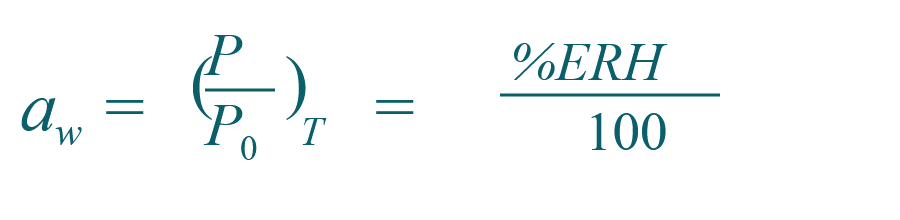
This water activity index covers a range from 0 for bone-dry conditions up to 1.00 for pure water, when the partial pressure and the saturated pressure are equal. Water activity is often referred to as “free water,” which is useful when referring to higher energy; however, it is misleading because “free” is not scientifically defined and is interpreted differently depending on the context. As a result, the concept of free water can cause confusion between the physical binding of water, a quantitative measurement, and the chemical binding of water to lower energy, a qualitative measurement. Rather than a water activity of 0.50, indicating 50% free water, it more correctly indicates that the water in the product has 50% of the energy that pure water would have in the same situation. The lower the water activity, the less the water in the system behaves like pure water. Water activity is measured by equilibrating the liquid-phase water in the sample with the vapor-phase water in the headspace of a closed chamber and measuring the ERH in the headspace using a sensor. The relative humidity can be determined using a resistive electrolytic sensor, a chilled mirror sensor, or a capacitive hygroscopic polymer sensor. Instruments from Novasina, like the LabMaster NEO, utilize an electrolytic sensor to determine the ERH inside a sealed chamber containing the sample. Changes in ERH are tracked by changes in the electrical resistance of the electrolyte sensor. The advantage of this approach is that it is very stable and resistant to inaccurate readings due to contamination, a particular weakness of the chilled mirror sensor. The resistive electrolytic sensor can achieve the highest level of accuracy and precision with no maintenance and infrequent calibration, making it ideal for pharmaceutical testing.
WATER ACTIVITY VS. MOISTURE CONTENT
Water activity is an intensive property that describes the energy of the water in a system, whereas moisture content is an extensive property that determines the amount of moisture in a product. Although related, water activity and moisture content are not the same: moisture content is typically determined through loss-on-drying or chemical titration; though useful as a measurement of purity and a standard of identity, moisture content does not correlate as well as water activity with microbial growth, chemical stability, or physical stability. Water activity and moisture content are related through the moisture sorption isotherm.
REGULATORY INFORMATION
International Conference on Harmonization (ICH) ICH has published testing procedures and acceptance criteria for drug release programs in ICH Q6A, where decision trees #6 and #8 provide best practice for determination of microbiological attributes of a drug. It links physical properties of a product together with lower microbial risk by making a product just “dry enough.” Although not specifically defined, “dry” may be assumed to refer to moisture content. However, from USP <922> and USP <1112>, we know that microbial growth is determined by water activity and not moisture content. A second ICH chapter of relevance in terms of aW is ICH Q1A, which focuses on stability testing of new drug substances and products, and includes some generic descriptions about appropriate microbial attribute tests among others, including: • Replacement of microbial testing with water activity testing • Relationship of moisture content to water activity for microbiological stability • Possible stability protocol, outlining microbial and water activity testing. As mentioned previously, microbial control is just one good reason for water activity testing. But as many API and pharma products are below the critical limit of 0.60 aW (as specified in USP <1112>), water activity becomes much more a priority and focus to establish and assure product properties, stability and quality.
USP <1112> Water Activity for pharma is described in USP <1112> APPLICATION OF WATER ACTIVITY DETERMINATION TO NONSTERILE PHARMACEUTICAL PRODUCTS ( as an aid to: • Optimize product formulations to improve antimicrobial effectiveness of preservative systems • Reduce the degradation of active pharmaceutical ingredients within product formulations susceptible to chemical hydrolysis • Reduce the susceptibility of formulations (especially liquids, ointments, lotions, and creams) to microbial contamination • Provide a tool for the rationale to reduce the frequency of microbial limit testing and screening for objectionable microorganisms for product release and stability testing using methods contained in the general test chapter Microbial Enumeration Tests USP <61> and Tests for Specified Microorganisms USP <62>. In summary, water activity should be included as a critical control point in any drug release program as a tool for microbial risk control. However, of equal importance is the role water activity plays in mitigating the loss of active ingredients due to degradation, changes in dissolution rates, and preventing moisture migration. One limitation in USP <1112> is that it did not provide any guidance for conducting water activity tests because it was an information chapter, making it harder for pharma companies to implement water activity testing with no SOP or validation guidance. This limitation has been now addressed with the pending USP <922>. USP <795> and <797>
These chapters provide guidelines for pharmaceutical compounding, both sterile and non-sterile preparations.
In these chapters, water activity is the determining factor for whether a preparation is classified as aqueous or non-aqueous. It also states that water activity should be considered when determining beyond-use dates.
STANDARD METHODS – USP <922>
USP <922> Recommendations for the determination of water activity are outlined in USP <922> Water Activity. This method becomes official in May 2021 and provides guidance for water activity measurement. It includes a brief theoretical background explanation and discusses some factors that influence water activity including solute concentration and temperature. Sensor types and calibration USP <922> also provides a short review of the various sensor types available for measuring water activity and highlights the strengths of each. It provides guidance on the qualification of instruments with water activity instruments classified as Group B instruments. It highlights that water activity meters should be calibrated using standard solutions and this should be done at a minimum yearly or whenever a calibration check fails. Calibration checks should be conducted daily based on the instructions from the instrument manufacturer and using a minimum of two standards that bookend the typical water activity range. The number of replicates used for a calibration check should match the number of replicates used for sample testing. Sampling For sampling, guidance is given to limit exposure of the sample to ambient conditions by using sealed containers with limited headspace. The transfer of samples from extreme temperatures is discouraged due to the potential for condensation to form inside the containers. Water activity measurements should be conducted according to the manufacturer’s instructions and reported along with the temperature. Applications: In terms of suggested uses for water activity, USP <922> extends beyond the usage suggestions of USP <1112> to include: • Selecting ingredient isolation and product manufacturing process conditions in terms of maintaining aw below the critical threshold to obtain thermodynamic control of the desired solid form (e.g., hydrate versus anhydrate) • Selecting excipients for which aw may impact their material flow, compression characteristics, hardness, and performance characteristics (e.g., disintegration and dissolution) of dosage forms • Optimizing fluidized bed drying processes
- Reducing the degradation of active ingredients within product formulations (e.g., those susceptible to
chemical hydrolysis) - Establishing the level of protection to product formulations to moisture by primary packaging materials
during their shelf life - Optimizing the shelf-life stability of probiotics
- Providing a complementary method for monitoring changes in water content
- Controlling and monitoring physical, chemical, and microbial product stability
- Optimizing formulations to improve the antimicrobial effectiveness of preservative systems
- Reducing the susceptibility of formulations to microbial contamination
- Providing a tool to justify the reduction of microbial testing of nonsterile drug and dietary supplements formulations (see Application of Water Activity Determination to Nonsterile Pharmaceutical Products 1112)
Let’s take a look at each of these applications in turn.
CRITICAL WATER ACTIVITY FOR CRYSTALLINE EXCIPIENTS
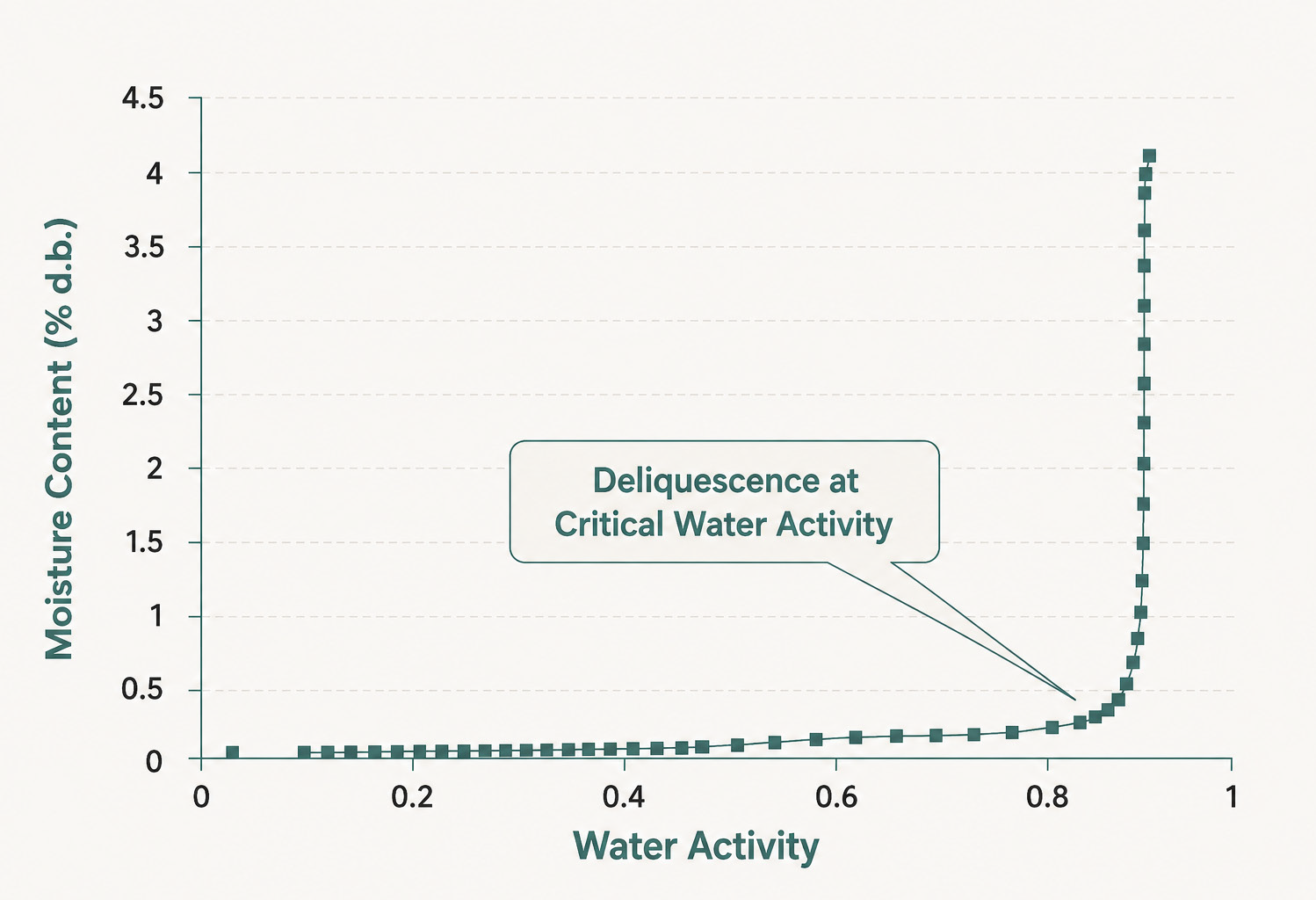
Excipients, among many functions, act as bulking agents and protect Active Pharmaceutical Ingredients (API) in pharmaceutical solid dosage products. Typically, the matrix of these excipients is either crystalline or amorphous. For crystalline excipients, the addition or loss of waters of hydration or deliquescence can result in undesirable changes in product quality such as modification of dissolution properties or reduction in the efficacy of the API. These change processes are thermodynamically controlled and, therefore, are related to water activity. The moisture sorption isotherm, which describes the relationship of moisture content to water activity, of a crystalline material will clearly show the gain and loss of waters of hydration as an abrupt increase in moisture content as water activity increases, and an abrupt loss in moisture as water activity decreases. Deliquescence of the crystalline material is indicated on the moisture sorption isotherm by a sharp 90 degree turn in the isotherm (Figure 1).
The water activity where these changes occur is called “critical water activity.” The key to avoiding problems with a crystalline excipient is to specify that the water activity be in a safe range based on the critical water activities identified through the moisture sorption isotherm. Any incoming excipient supplies should then be monitored for water activity to ensure that this specification is being met.
CRITICAL WATER ACTIVITY FOR AMORPHOUS EXCIPIENTS
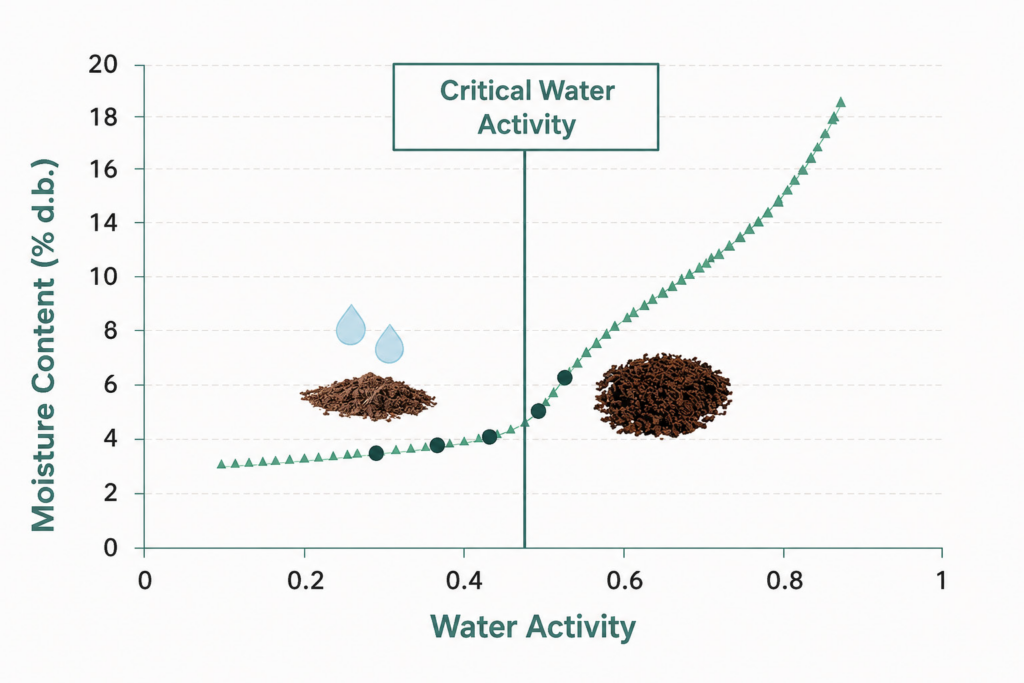
Amorphous excipients are typically low-moisture and are in a meta-stable glassy state. Their ability to provide protection to the API depends on them remaining in the glassy state throughout the life of the product. A transition of the excipient matrix from the glassy state to the rubbery state, called a “glass transition,” will result in structural collapse, increased mobility, changes in dissolution, and increased susceptibility to caking and crystallization. Consequently, the product will not flow, compress, or tablet properly, and dissolution may occur prematurely. A glass transition can be induced through either a change in temperature or a change in water activity. The water activity where a glass transition occurs for a product is called the “critical water activity” and can be identified as a sharp inflection in the moisture sorption isotherm (Figure 2). To maintain the functionality of amorphous excipients, it is important to determine its critical water activity and take measures to ensure that the water activity of the product remains below that critical water activity throughout the life of the product.
WATER ACTIVITY AND MICROBIAL SAFETY
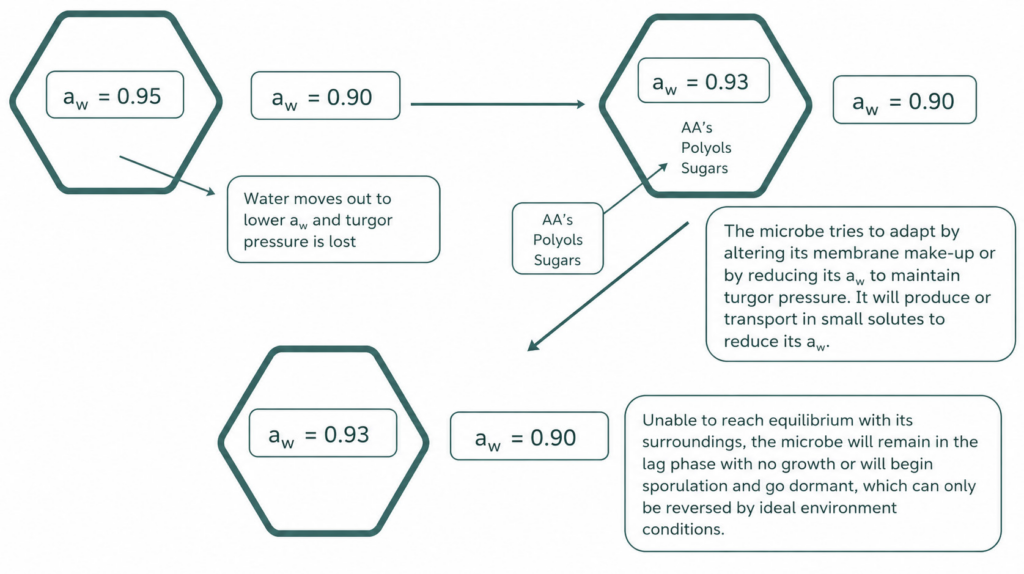
Microorganisms require access to water of a sufficient energy to allow for movement of water into the cell. This water is critical for maintaining turgor pressure and normal metabolic activity. The energy of the water surrounding the microorganism is described by the water activity and for water to move into the microbe, the interior water activity of the organism must be lower than the water activity of its surroundings. In other words, water activity is not the water available to microorganisms to grow; it is the energy of the water that determines if water can move into or out of the cell. When a microorganism encounters an environment
with lower water activity than its internal water activity, it experiences osmotic stress and water leaves the cell, thereby lowering the turgor pressure and causing metabolic activity to cease (Figure 3). In response, the organism will try to control its internal water activity through the concentration of solutes. This ability to lower the internal water activity is unique to each organism, which is why different microorganisms have different water activity minimum growth limits (Table 1). Notice that moisture content has not been mentioned as having an impact on microbial growth because it is not the amount of water that determines if a microorganism can access it but its water activity (energy) compared to the internal water activity of the organism. Consequently, any efforts to provide control limits for the risk of microbial contamination, and an accompanying reduction in microbial limits testing, must be based on water activity measurements and not moisture content.
| aw limit | Microorganisms |
| 0.91 | Gram negative bacteria |
| 0.86 | Gram positive bacteria |
| 0.88 | Yeast (practical limit) |
| 0.80 | Production of mycotoxins |
| 0.70 | Molds (practical limit) |
| 0.60 | Absolute limit for all growth |
WATER ACTIVITY AND DEGRADATION OF ACTIVE INGREDIENTS
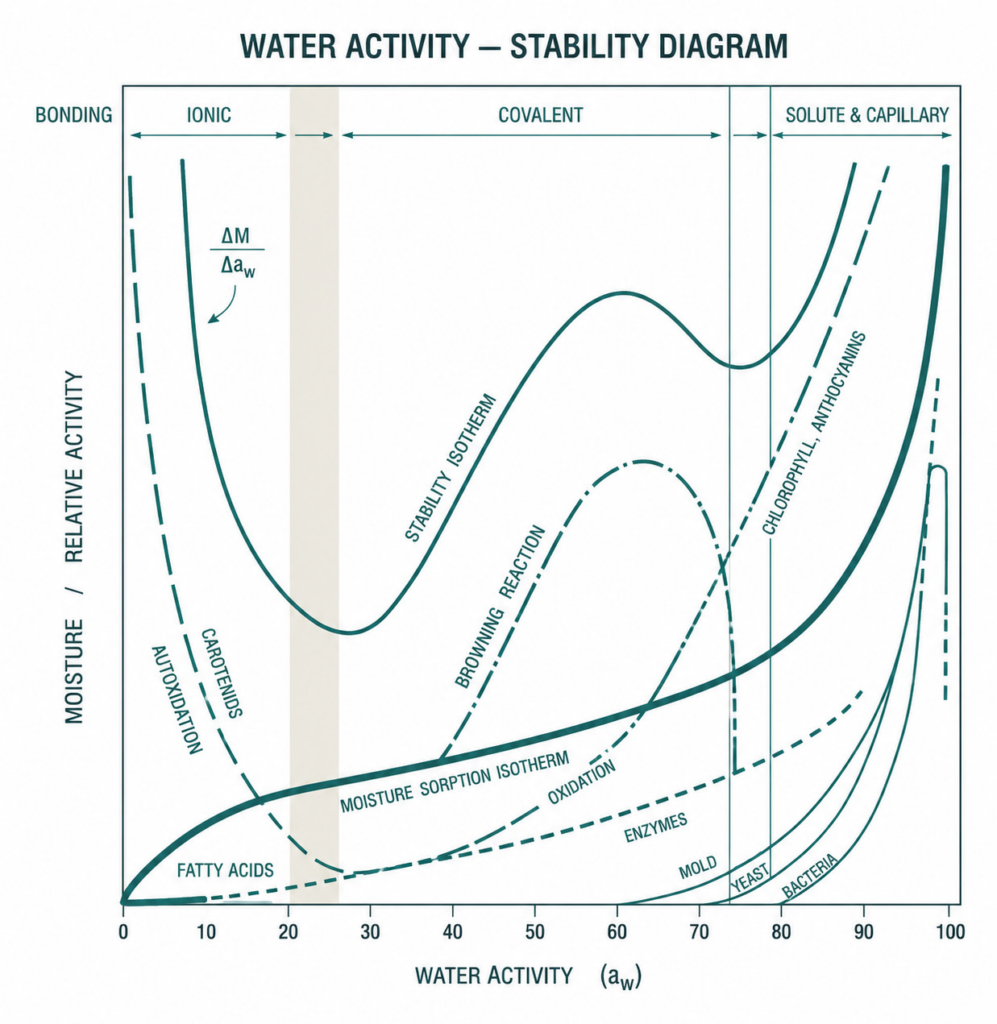
The water activity of solid dosage pharmaceuticals will typically be less than 0.70 , indicating that microbial growth is not likely to occur. However, products in this range do not have an unlimited shelf life. For these products in the 0.40–0.70 aw range, chemical degradation of the API is a strong candidate for the mode of failure because reaction rates are at a maximum. In general, as water activity increases so do reaction rates; however, lipid oxidation is unique in that the reaction rate also increases at very low water activity (Figure 4). The most common reaction that can result in the degradation of APIs is hydrolysis although lipid oxidation (rancidity) and enzymatic reactions may also play a role in the loss of active ingredients. The most effective way to prevent these reactions from resulting in significant loss of the API is to process them to a low water activity where reactions will be at a minimum and then choose the appropriate excipient that will do the best job of maintaining that water activity. As explained in the earlier sections on excipients, staying below the critical water activity is the best way to maintain stability because a glass transition will also result in a substantial increase in reaction rate. Therefore, the key to preventing the loss of API efficacy is to maintain the water activity of the API at a level that minimizes the rate of degradative reactions.
WATER ACTIVITY AND SHELF-LIFE STABILITY
When chemical reactions rendering the API ineffective is the mode of failure, the time required for the reaction to have progressed to the point of unacceptability at a given water activity and temperature will be the product’s shelf life. If the rate constants for these reactions at several different storage conditions are determined, then a predictive model can be used to estimate the time needed for the reaction to proceed to an unacceptable level under any storage conditions. To do this, the progress of the reaction will need to be tracked using some type of quantitative assessment.
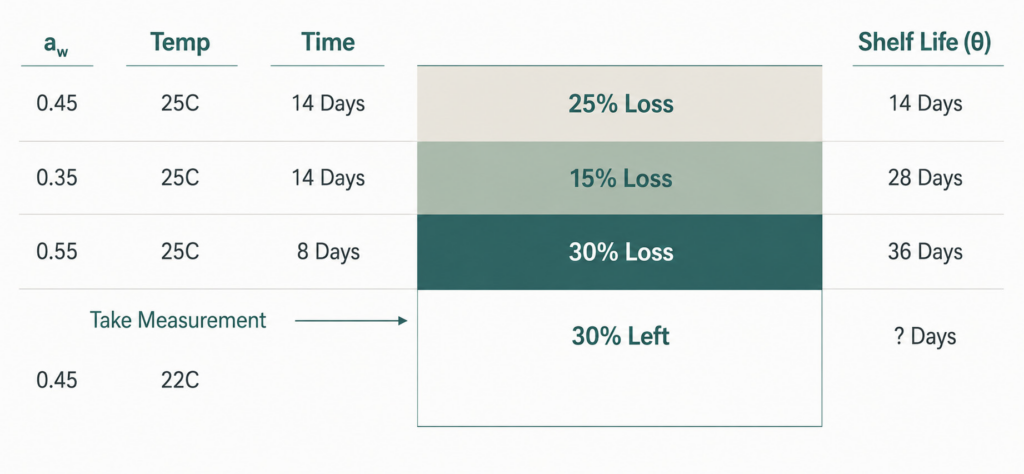
While there are examples of shelf life models in the literature, the only fundamental model that includes both water activity and temperature is hygrothermal time. This measure derives from a form of the Eyring equation for rate change, with Gibbs equation for free energy substituted in as follows:
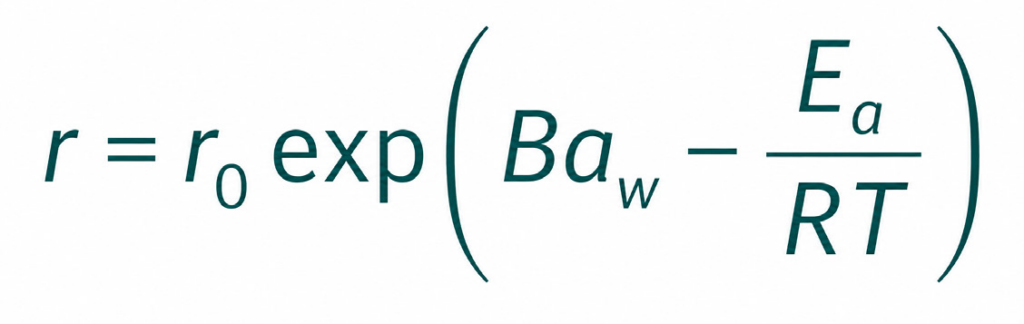
where T is the temperature (K), R is the gas constant (J mol−1 K−1), Ea is the activation energy (J mol−1), B is the molecular volume ratio, aw is the water activity, and r0 is the rate at the standard state (Carter et al. 2017). In practice, the values for B, Ea/R, and r0 will be unique to each situation and are derived empirically through least squares iteration. Once the constants are known, any temperature and water activity can be used with the hygrothermal time model to determine the rate of oxidation at those conditions; hence, the shelf life that
the product will remain acceptable to the consumer (Figure 5).
TRACKING MOISTURE CHANGE WITH WATER ACTIVITY
As shown by the moisture sorption isotherm, an increase in water activity is accompanied by a subsequent increase in moisture; however, the relationship is non-linear and unique to each product. An increase in the slope of the isotherm indicates an increase in hygroscopicity, which will limit the change in the water activity as moisture is absorbed. This is often a desirable characteristic in excipients because it allows the product to absorb moisture while still maintaining the water activity of the API at levels that limit the rate of degradative reactions as shown in the previous section. Another way that the water activity of an API can increase to
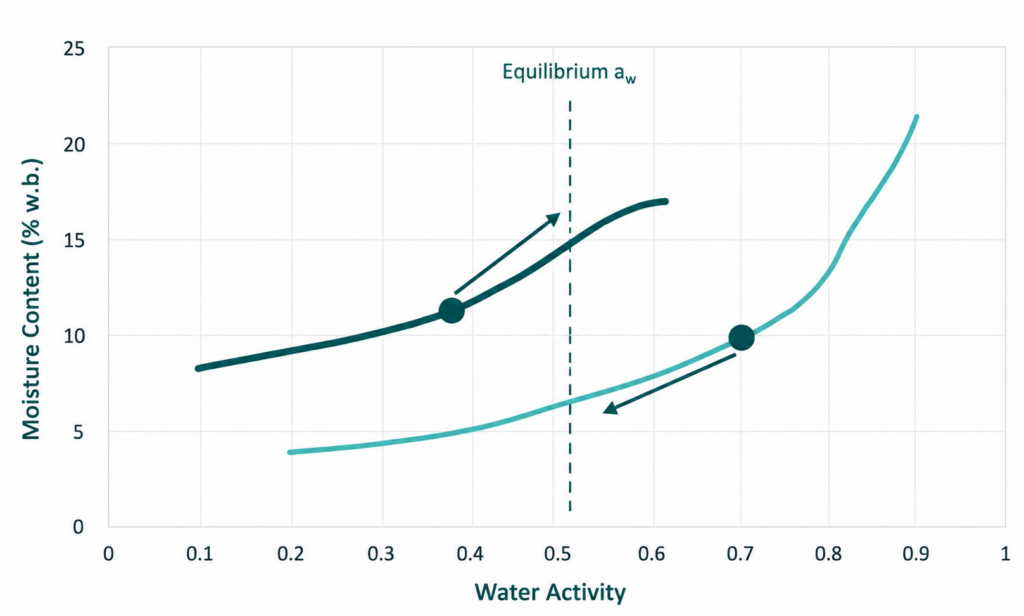
unsafe levels is through moisture migration in multiple component pharmaceuticals such as capsules. If the components are at different water activities, then water will move between the components regardless of their moisture content. Water moves from high water activity (energy) to low water activity (9). Moisture will continue to move between the components until an equilibrium water activity is achieved, which is dictated by the moisture sorption isotherms of each component and is not the midpoint between the initial water activities (Figure 6). If the water activity of the API increases, it could possibly be at high enough levels to speed up degradation. To avoid this problem, the components must be designed to have the same water activity.
WATER ACTIVITY AND PACKAGING SELECTION
Once the ideal water activity is identified, it is critical that the product stay at that water activity during transit and storage. Water activity changes can occur due to exposure to ambient room humidity. As described in the theory section earlier, water activity is also the equilibrium relative humidity and related to the storage humidity. If a product with a water activity of 0.40 aw is exposed to a storage relative humidity of 60%, then the product will absorb water from the environment until its water activity is equilibrated to 0.60 aw. This process, of course, takes time. However, if not protected, then the water activity of the product will increase outside the ideal range and lose stability. Placing the product in moisture barrier packaging will slow down the change in water activity. The moisture barrier properties of packaging are most often reported as water vapor transmission rates (WVTR) and should be available for any packaging material from the manufacturer. While it is certainly important to use packaging with a WVTR value low enough to prevent water activity change, it is also possible to over-package, resulting in unnecessary expense. The rate of water activity change inside a package of known WVTR can be modeled using Fickian diffusion as can the required package permeability to
achieve a desired shelf life.
THE MOST IMPORTANT SPECIFICATION
Water activity is sometimes an overlooked and underestimated parameter in pharma quality and formulation. However, along with moisture sorption isotherms, it offers critical information for optimizing product stability. Issues with deliquescence, caking and clumping, dissolution, microbial susceptibility, API degradation etc. can be resolved by identifying the ideal water activity range for the product and implementing water activity measurement as a routine parameter for batch release. Water activity experts at Novasina are ready to assist you in determining the ideal water activity range for your pharmaceutical product. Once you have this knowledge, enormous benefits and profitable returns can be realized simply by conducting water activity testing according to USP <922>. Contact Novasina or the distributor in your area to learn more about the water activity solutions provided by Novasina.

REFERENCES
- Bell, L. N., & Labuza, T. P. (2000). Moisture Sorption: Practical Aspects of Isotherm Measurement and Use
(Vol. Second) 2. St. Paul, MN: American Association of Cereal Chemists.
- Beuchat, L. 1983. Influence of water activity on growth, metabolic activities and survival of yeasts and molds. Journal of Food Protection 46(2):135-141.
- Carter, B.P and S.J. Schmidt. 2012. Developments in glass transition determination in foods using moisture sorption isotherms. Food Chemistry 132:1693-1698.
- Carter, B. P., Syamaladevi, R. M., Galloway, M. T., Campbell, G. S., & Sablani, S. S. 2017. A Hygrothermal
Time Model to Predict Shelf Life of Infant Formula. In U. Klinkesorn (Ed.), Proceedings for the 8th Shelf Life International Meeting (pp. 40–45). Bangkok Kasetsart University.
- Carter, B.P. 2020. Applications for Dynamic Moisture Sorption Profiles in Foods. In Water Activity in Foods: Fundamentals and Applications, 2nd Edition. Wiley-Blackwell.
- Potts, M. 1994. Desiccation tolerance of prokaryotes. Microbiological Reviews 58:755-805.


