

WATER ACTIVITY IN COSMETICS: SAFETY AND QUALITY
This powerful but under-used quality parameter is gaining interest in the Cosmetic Industry with the release of ISO 29621 The cosmetic industry is valued at $511 billion with hundreds of brands and product types. The product range is immense covering everything from soap and shampoo to eye liner and eye shadow. Each of these products is unique in its purpose, ingredients, and physical characteristics. All these products are applied topically to the skin in some way or another, and it is essential that they are safe and deliver the advertised functionality. Since cosmetic products can have a wide range of water activities (Table 1), measuring the water activity of a cosmetic product is critical to determining how susceptible the product is to microbial contamination and to delivering consistent product quality.
INTRODUCTION
In 2017, ISO 29621 Cosmetics — Microbiology — Guidelines for the risk assessment and identification of microbiologically low-risk products was published identifying water activity as one of the most important factors in determining the potential for microbial growth in cosmetics. Water activity, not moisture content, determines whether microorganisms in cosmetics can access water for growth. Each microorganism requires a unique water activity level to grow, while all organisms stop growing at water activities less than 0.600 aw. Water activity also has a stronger correlation with the chemical and physical stability of cosmetics. In general, as water activity is reduced, the rate of chemical reactions such as oxidation and hydrolysis are reduced, extending the shelf life of the cosmetic. However, lowering water activity also typically results in changes in the physical properties of cosmetic products, which may be undesirable. The key is to determine the ideal water activity range for each cosmetic product and to implement it as a required release specification. In addition, it would be necessary to implement water activity testing as a routine QA test to ensure that the product is being made to this ideal water activity.
| Tpe of Cosmetic Product | aw Value |
| Foundation | 0.68 |
| Hand Cream | 0.96 |
| Loose Body Powder | 0.76 |
| Lipstick | 0.68 |
| Mascara | 0.96 |
| Powdered Eyeshadow | 0.76 |
| Shampoo | 0.99 |
| Shampoo Conditioner | 0.97 |
| Toothpaste | 0.86 |
| Wet/Dry Eyeshadow | 0.57 |
Figure 1. Moisture sorption isotherm indicating the critical water activity for a glass transition. Below the critical water activity, the product remains stable. Above the critical water activity, the product becomes unstable and shelf life is reduced. (Adapted from Carter and Schmidt 2012)
WATER ACTIVITY AND MICROBIAL SAFETY
Microorganisms require access to water of a sufficient energy to allow for movement of water into the cell. This water is critical for maintaining turgor pressure and normal metabolic activity. The energy of the water surrounding the microorganism is described by the water activity and for water to move into the microbe, the interior water activity of the organism must be lower than the water activity of its surroundings. In other words, water activity is not the water available to microorganisms to grow; it is the energy of the water that determines if water can move into or out of the cell. When a microorganism encounters an environment with lower water activity than its internal water activity, it experiences osmotic stress and water leaves the cell, thereby lowering the turgor pressure and causing metabolic activity to cease (Figure 2). In response, the organism will try to control its internal water activity through the concentration of solutes. This ability to lower the internal water activity is unique to each organism, which is why different microorganisms have different water activity minimum growth limits (Table 2). Notice that moisture content has not been mentioned as having an impact on microbial growth because it is not the amount of water that determines if a microorganism can grow, but its water activity (energy) compared to the internal water activity of the organism. Consequently, any efforts to provide control limits for the risk of microbial contamination, and an accompanying reduction in microbial limits testing, must be based on water activity measurements and not moisture content.
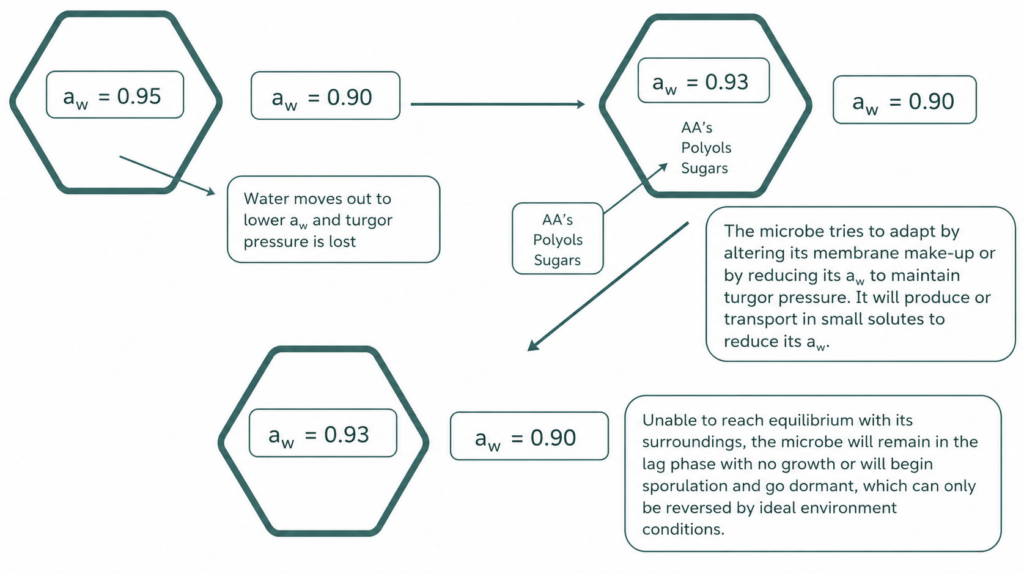
Due to its connection to microbial growth, water activity can be considered the best natural preservative for cosmetic products. In addition, as water activity is an intrinsic property of the product, it is more reliable than microbial challenge testing at ensuring the microbial safety of cosmetic products. A negative challenge test only indicates that microorganisms were not at infection levels in the sample tested but does not mean that contaminants could not be present in a non-sampled part of the product. In situations where the water activity of a cosmetic product falls above the critical 0.70 aw cutoff, additives known as humectants can be added to lower the water activity without drying the product. Kerdudo et al. (2015) showed that glycerin is a particularly effective humectant in controlling water activity in cosmetic products and reduces the risk of microbial contamination. The humectant concentration needed to achieve a desired reduction in water activity can be modeled using the Norrish equation (Bell and Labuza, 2000).
| aw Limit | Microorganisms |
| 0.91 | Gram negative bacteria |
| 0.86 | Gram positive bacteria |
| 0.88 | Yeast (practical limit) |
| 0.80 | Production of mycotoxins |
| 0.70 | Molds (practical limit) |
| 0.60 | Absolute limit for all growth |
Table 2. Minimum water activity levels required for the growth of various microorganisms (adapted from Buechat 1983)
WATER ACTIVITY AND CHEMICAL STABILITY
Cosmetics with water activity less than 0.70 aw will not be susceptible to microbial growth. However, products in this range do not have an unlimited shelf life. These products in the 0.40–0.70 aw range, in which reaction rates are at a maximum, are at high risk of failure due to chemical degradation. In general, as water activity increases so do reaction rates; however, lipid oxidation is unique in that the reaction rate also increases at very low water activity (Figure 3). The most common reaction that can result in the degradation of cosmetics is hydrolysis or lipid oxidation (rancidity), while enzymatic reactions may also play a role in quality loss. Reactions that result in color change such as non-enzymatic browning may also be of concern for products designed to have specific color characteristics. The most effective way to prevent these reactions from resulting in product failure is to process them to a low water activity where reactions will be at a minimum and then maintain that water activity. However, minimizing chemical reactions by lowering water activity may not always be an option due to the impacts low water activity can have on the product’s physical properties. The challenge then is to determine the water activity that will deliver the desired physical quality while also sufficiently slowing reaction rates to achieve the desired shelf life. The next section will describe how the rate of reaction can be modeled to water activity and temperature, allowing the shelf life to be determined at the target water activity.
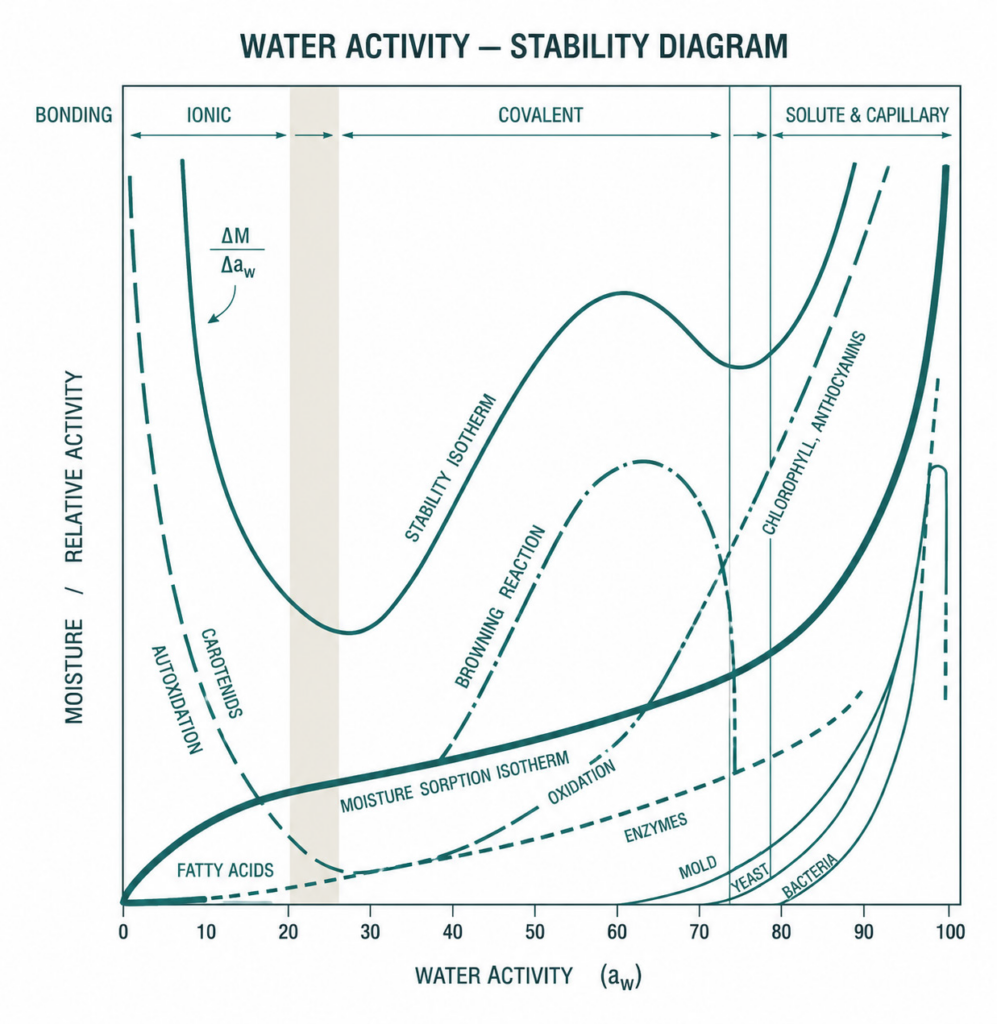
WATER ACTIVITY AND SHELF-LIFE STABILITY
When chemical reactions causing unwanted changes are the mode of failure for a cosmetic, the time required for the reaction to have progressed to the point of unacceptability at a given water activity and temperature will be the product’s shelf life. If the rate constants for these reactions at several different storage conditions are determined, then a predictive model can be used to estimate the time needed for the reaction to proceed to an unacceptable level under any storage conditions. To do this, the progress of the reaction will need to be tracked using some type of quantitative assessment. While there are examples of shelf-life models in the literature, the only fundamental model that includes both water activity and temperature is hygrothermal time. This measure derives from a form of the Eyring equation for rate change, with Gibbs equation for free energy substituted in as follows:
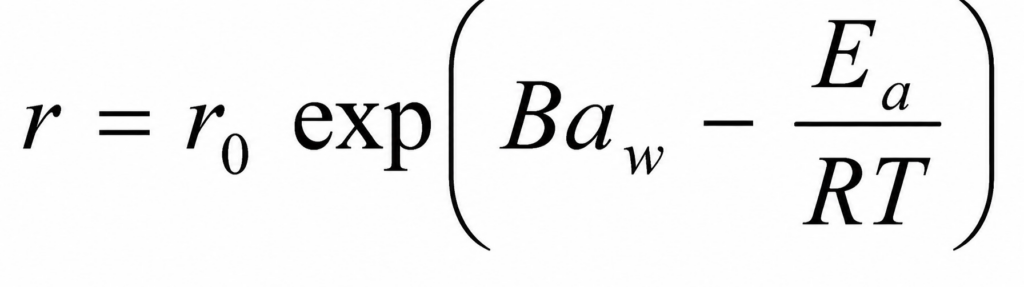
where T is the temperature (K), R is the gas constant (J mol−1 K−1), Ea is the activation energy (J mol−1), B is the molecular volume ratio, aw is the water activity, and r0 is the rate at the standard state (Carter et al. 2017). In practice, the values for B, Ea/R, and r0 will be unique to each situation and are derived empirically through least squares iteration. Once the constants are known, any temperature and water activity can be used with the hygrothermal time model to determine the reaction rate at those conditions; and hence, the shelf life of the product.
TRACKING MOISTURE CHANGE WITH WATER ACTIVITY
As shown by the moisture sorption isotherm, an increase in water activity is accompanied by a subsequent increase in moisture; however, the relationship is non-linear and unique to each product. An increase in the slope of the isotherm indicates an increase in hygroscopicity, which will limit the change in the water activity as moisture is absorbed. This is often a desirable characteristic in cosmetics because it allows the product to absorb moisture while still maintaining the water activity at levels that limit the rate of degradative reactions as shown in the previous section. Another way that the water activity of a cosmetic can change to unsafe levels is through moisture migration when multiple cosmetics are packaged together such as in a makeup kit. If the cosmetics are at different water activities, then water will move between them regardless of their moisture content (Fontana and Mumford 2005). Water moves from high water activity (energy) to low water activity and not from high to low water concentration. Moisture will continue to move between the products until an equilibrium water activity is achieved, which is dictated by the moisture sorption isotherms of each product and is not the midpoint between the initial water activities (Figure 4). If this equilibrium water activity is outside the safe range for one of the products, it could lead to the failure of a product that was initially at a safe water activity. To avoid this problem, the cosmetics must be designed to have the same water activity. If multiple cosmetics do have to be combined at different water activity levels in a container, then a model can be used to predict the final equilibrium water activity and it can be determined if stability of any of the cosmetics will be lost at that final water activity (Bell and Labuza 2000)
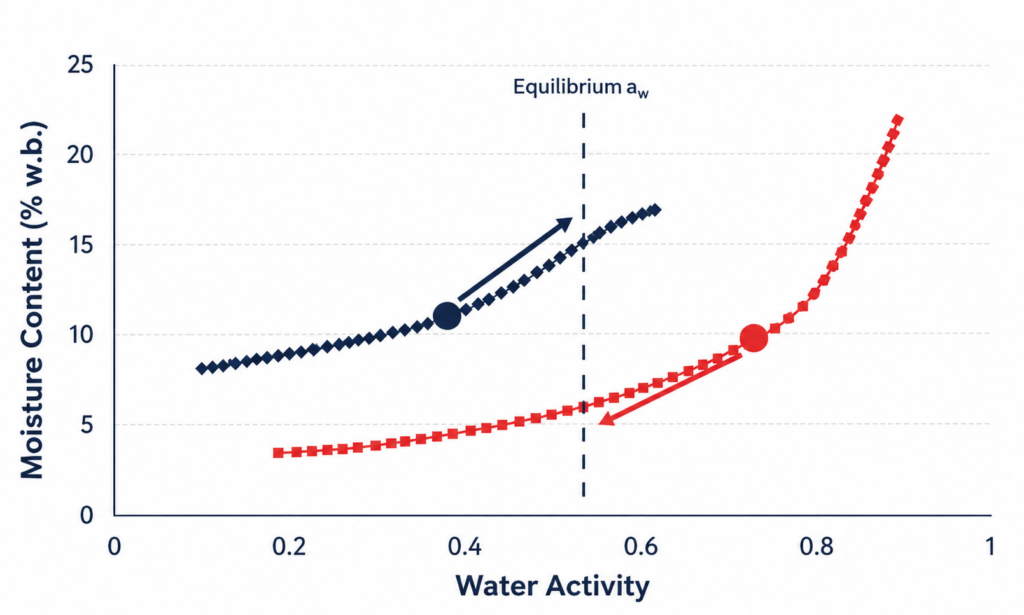
Figure 4. Moisture sorption isotherms for a product with two components at different initial water activities. The black dots indicate the initial water activity while the arrows indicate the direction of water movement for each component and the accompanying change in moisture content. The dotted vertical line indicates the water activity where the components will come into equilibrium and moisture movement will stop. The points where the isotherm curves cross the dotted vertical line indicate the moisture content of each component at the final water activity. (Adapted from Bell and Labuza 2000)
WATER ACTIVITY AND PACKAGING SELECTION
Once the ideal water activity is identified, it is critical that the product stay at that water activity during transit and storage. Water activity changes can occur due to exposure to ambient room humidity. As described in the theory section earlier, water activity is also the equilibrium relative humidity and related to the storage humidity. If a cosmetic product with a water activity of 0.40 aw is exposed to a storage relative humidity of 60%, then the product will absorb water from the environment until its water activity has equilibrated to 0.60 aw. This process, of course, takes time. However, if not protected, then the water activity of the product could move outside its ideal range and lose stability. Placing the product in moisture barrier packaging will slow down the change in water activity. The moisture barrier properties of packaging are most often reported as water vapor transmission rates (WVTR) and should be available for any packaging material from the manufacturer. While it is certainly important to use packaging with a WVTR value low enough to prevent water activity change, it is also possible to over-package, resulting in an unnecessary expense. The rate of water activity change inside a package of known WVTR can be modeled using Fickian diffusion as can the required package permeability to achieve a desired shelf life (Bell and Labuza 2000).
CONCLUSION
Water activity has not been fully utilized in the cosmetic industry due to a lack of guidance and justification. However, along with moisture sorption isotherms, it offers critical information for optimizing product stability. With the publication of ISO 29621, cosmetic manufacturers now have the guidance and validation they need to begin fully utilizing water activity testing. Issues with caking and clumping, microbial susceptibility, chemical degradation etc., can be resolved by identifying the ideal water activity range for a cosmetic and implementing water activity measurement as a routine parameter for batch release. Water activity experts at Novasina are ready to assist you in determining the ideal water activity range for your cosmetic product. Once you have this knowledge, enormous benefits and profitable returns can be realized simply by conducting water activity testing. Contact Novasina or their distributor in your area to learn more about the water activity solutions provided by Novasina.

REFERENCES
- Bell, L. N., & Labuza, T. P. (2000). Moisture Sorption: Practical Aspects of Isotherm Measurement and Use
(Vol. Second) 2. St. Paul, MN: American Association of Cereal Chemists.
- Beuchat, L.1983. Influence of water activity on growth, metabolic activities and survival of yeasts and molds. Journal of Food Protection 46(2):135-141.
- Carter, B.P and S.J. Schmidt. 2012. Developments in glass transition determination in foods using moisture sorption isotherms. Food Chemistry 132:1693-1698.
- Carter, B. P., Syamaladevi, R. M., Galloway, M. T., Campbell, G. S., & Sablani, S. S. 2017. A Hygrothermal
Time Model to Predict Shelf Life of Infant Formula. In U. Klinkesorn (Ed.), Proceedings for the 8th Shelf Life International Meeting (pp. 40–45). Bangkok, Thailand: Kasetsart University.
- Carter, B.P. 2020. Applications for Dynamic Moisture Sorption Profiles in Foods. In Water Activity in Foods: Fundamentals and Applications, 2nd Edition. Wiley-Blackwell
- Fontana, A. J., & Mumford, J. (2005). Incorrect Water Measurements Costly; Water activity is key to pharmaceutical safety and quality. Pharmaceutical Formulation and Quality, 7(6), 63–66.
- Fontana, A.J. and Schmidt, S.J. 2020. Appendix F: Water activity values of select consumer and pharmaceutical products. In Water Activity in Foods: Fundamentals and Applications, 2nd Edition. Wiley-Blackwell.
- Kerdudo, A., Fontaine-Vive, F., Dingas, A., Faure, C., & Fernandez, X. (2015). Optimization of cosmetic preservation: Water activity reduction. International Journal of Cosmetic Science, 37(1), 31–40.
- Potts, M. 1994. Desiccation tolerance of prokaryotes. Microbiological Reviews 58:755-805.
- Roos, Y.H. 2020. Water activity and glass transition. In Water Activity in Foods: Fundamentals and Applications, 2nd Edition. Wiley-Blackwell.
Get in touch and learn more about your specific application and its possibilities! sales@novasina.ch


