

WATER ACTIVITY TEST TIME: IT’S THE SAMPLE, NOT THE INSTRUMENT
There can be an abundance of confusion with water activity instruments concerning test time. Some instruments claim a 5-minute test time, while others offer fast or quick modes. Water activity test time is primarily driven by the physical and chemical characteristics of the sample, not by the instrument itself. Since water activity is an equilibrium measurement, a reading is not complete until vapor equilibrium has been fully achieved.
Therefore, any claim to a fixed test time is misleading and would only be true for selected sample types under defined conditions. Test times of 5 minutes or less are often based on prediction models or end-of-test settings that are not stringent enough to ensure true vapor equilibrium. In such cases, the result may not represent the true water activity of the sample. This can lead to incorrect quality decisions and, in critical applications such as food safety or pharmaceutical stability, may create significant product and compliance risks.
That said, the measurement conditions can and should be optimized. Proper temperature stabilization, consistent sample preparation, correct sample filling, clean measurement chambers, and well-defined measurement process steps can help the sample reach equilibrium more efficiently and reproducibly. However, even under optimized conditions, the final test time remains sample-dependent. The true water activity value is only reached once the sample and the measuring chamber have achieved real vapor equilibrium.
Imagine: You put a thermometer into a bowl of hot soup. If you read the temperature after only a few seconds, the thermometer will show a number. But it may not be the true temperature of the soup yet, because the thermometer has not had enough time to stabilize.
END OF TEST REQUIREMENTS
To determine when vapor equilibrium has been achieved and a test should end, instrumentation looks for the rate of water activity change to fall below some setpoint. What setpoint is used and how it is determined will impact both test time and reliability. If the setpoint is set to too low a stringency, the test could end prematurely before true equilibrium has been achieved. On the other hand, setting the setpoint too stringent could result in unnecessarily long test times. The ideal system would allow the user to set the end-of-test setting to whatever best suits their situation and needs. Further, emphasis should be placed on understanding the equilibration process for a particular sample type so that educated decisions can be made about what setpoint to use. The most advanced water activity systems, such as the LabMaster-aw neo, provide an on-screen graph illustrating the equilibration process. This allows users to visually check how the sample stabilizes over time and to better judge whether true vapor equilibrium has been reached.
VAPOR EQUILIBRIUM AND TEST TIME
Some water activity instrumentation allows the user to adjust the end-of-test setpoint while others default to a low stringency setting to try to achieve fast test results. These low stringency settings typically only require achieving a preset water activity difference one time and then the test is ended. An instrument with a low stringency setpoint may give a reading in less than 5 minutes, but there is a chance that even though it met the end-of-test requirements, vapor equilibrium had not been achieved. If true, continuing to run the sample without opening the chamber should show a drift until true equilibrium has been achieved.
Figure 2 illustrates how this would happen. Water activity changes are fast initially, but then start to level out as vapor equilibrium is achieved, giving a typical equilibrium curve. The first vertical line in Figure 2 indicates where a test that uses a low stringency end-of-test requirement might end and give a result. However, notice that if a more stringent setpoint were used, the test would have continued through the equilibration process, giving a final value that is 0.03 water activity higher than the initial reading. Considering that the accuracy of the top water activity instruments is +/-0.003 water activity, a 0.03 water activity change is significant. Figure 2 indicates that faster results and higher reliability are mutually exclusive when it comes to water activity testing.
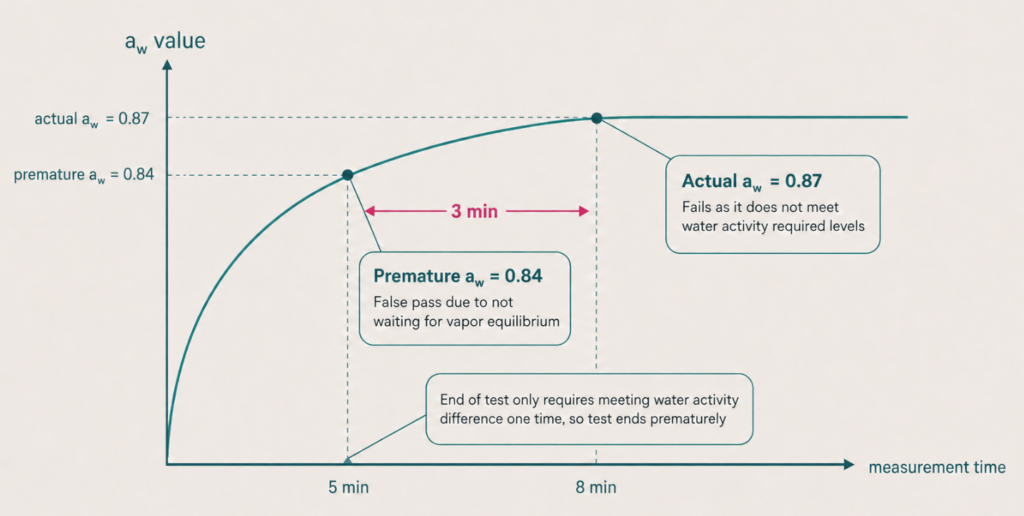
Figure 2 shows how stopping too early can report 0.84, while true vapor equilibrium is only reached later at 0.87.
The vapor equilibrium process is not determined by the instrument or the end-of-test settings, but by the thermodynamically controlled movement of water from the sample to the headspace. The ambiguity in end-of-test settings and their potential impact on testing results even led ISO to define the end-of-test requirements in their revised water activity method ISO 18787. Any water activity systems using this ISO 18787 setting will not give results as fast as with the default end-of-test settings due to its higher stringency.
HOW NOVASINA HANDLES END-OF-TEST SETTINGS
Unlike systems that default to a low-stringency end-of-test setting, Novasina allows the user to select more or less stringent conditions for ending the test. The most stringent setting in Novasina instruments requires that there be no change in water activity greater than 0.001 for 6 minutes. Repeated measurements using this setting will not show the drift seen with less stringent systems, because the setting is strict enough to ensure true vapor equilibrium.
Logically, the more stringent the end-of-test setting, the longer the test time may be. However, more stringent settings provide higher confidence that the result represents the true water activity of the sample.
Again, it is important to select the appropriate test setting based on the application, the user’s requirements, and the level of risk. The key question is how much deviation from the true water activity value can be accepted for the specific product and decision.The available end-of-test settings in Novasina instruments include:
Novasina instruments offer six different test modes, allowing users to choose the right balance between test speed and measurement confidence:
- At one end, the Fast mode is designed for shorter test times and ends the measurement once there is no change in water activity greater than 0.001 for 2 minutes.
- At the other end, the most stringent mode applies the most stringent setting and requires no change greater than 0.001 for 6 minutes, providing higher confidence that true vapor equilibrium has been reached.
- In addition, Novasina instruments offer an ISO 18787 mode, which follows the end-of-test requirements defined in the ISO 18787 water activity method.
Novasina supports users in selecting the most appropriate test mode for their specific needs, helping them balance reliable results with practical test times.
COMPARISON TESTING ON REAL SAMPLES
To illustrate the potential problems introduced by prematurely ending water activity tests before vapor equilibrium has been achieved, water activity tests were run on samples of crème filling, gummies, and beef jerky.
Subsamples taken from the same sample were measured in a dew point instrument in continuous mode and in the Novasina LabMaster-aw neo with the stability setting set to Fast, as described above.
The stable results produced by the LabMaster-aw neo were recorded, but the sample was left in the instrument, allowing the water activity to continue to be tracked and displayed on the screen. When the change in water activity was low enough that it would have triggered the end of the test using the most stringent stability setting, the test was stopped and the water activity value was recorded.
In the dew point instrument, the water activity value of each completed test in continuous mode was collected until a result differed from the previous test by less than 0.002 water activity.
The first test result from the dew point system was always faster than the test result obtained using the Fast stability setting on the LabMaster-aw neo. However, the difference between the first and second result in the dew point instrument was always greater than the reported accuracy of the instrument of 0.003 water activity for all products, indicating that the first test result was premature.
In addition, chilled mirror / dew point systems can only deliver highly accurate results if the mirror is in suitable condition. If the mirror is contaminated, dirty, or affected by sample residues, the instrument may no longer reflect the correct water activity value. This can be difficult to detect during routine use and usually requires frequent verification or calibration to confirm that the system is still measuring correctly.
Regular mirror cleaning is therefore essential for chilled mirror systems, but it can also be time-consuming and adds operational effort in daily QC workflows. These additional maintenance steps can lead to higher operating costs over time. The potential cost savings of using a Novasina water activity instrument in daily routine operation can be calculated here.
CONCLUSION
The results presented in this paper clearly show that true vapor equilibrium can require substantial time to achieve, and that end-of-test settings that are less stringent will give premature results that do not reflect the true water activity. If the initial water activity readings from the dewpoint system had been reported, they would have been incorrectly low by as much as 0.02 aw. For a product being made close to the cutoff for microbial growth, that difference could result in releasing unsafe product. The results further verify that neither the instrument, sensor, or end-of-test settings determine the time needed to reach vapor equilibrium. It is understandable that longer test times can be frustrating and there may be justification for using less stringent end-of-test settings for routine testing to improve test times, but this should never been done without first checking on how different these premature results will be from the true water activity. The Novasina water activity instruments are ideally suited to facilitate this because they allow the user to
- 1) adjust the end-of-test settings instead of defaulting to the least stringent setting to disingenuously appear to give fast test results and
- 2) continue to track the results on the graph after the test has completed to see how different the premature fast result will be from the true water activity.
Then, an informed decision can be made on whether faster test times are acceptable without putting the company at risk of recalling failed products.

REFERENCES
- Fontana, A.J. and Carter, B.P. 2020. Measurement of water activity, moisture sorption isotherms, and moisture content of
foods. In Water Activity in Foods: Fundamentals and Applications, 2nd Edition. Wiley-Blackwell. - International Organization for Standardization. 2017. Foodstuffs – Determination of water activity. ISO18787:2017. https://
www.iso.org/obp/ui/fr/#iso:std:63379


