
UNDERSTANDING AND CONTROLLING WATER ACTIVITY IN SPICES
A THOUSAND YEARS OF MAINTAINING SPICE QUALITY THROUGH WATER ACTIVITY CONTROL INTRODUCTION
Spices have played a defining role in human history, shaping global cuisine, trade, and cultural exchange for thousands of years. From ancient caravans crossing the Silk Road to the vast maritime routes forged during the Age of Exploration, spices such as pepper, cinnamon, and saffron fueled entire economies and inspired world changing voyages. Today, the spice industry continues to thrive as a global powerhouse, blending traditional farming practices with modern processing, quality control, and international commerce. As consumers increasingly seek diverse flavors, natural ingredients, and culinary authenticity, the spice market remains a vibrant and influential force in the food industry. Because spices play a distinctive role in regional cuisines and significantly influence cultural development, maintaining their quality is critically important. A key challenge is converting raw agricultural materials into stable, easily handled ingredients while preserving their characteristic organoleptic properties. Spices are traditionally traded in dried form, produced through either mechanical or natural drying (1). However, dried spices commonly experience caking or clumping, which complicates handling and decreases processing efficiency (2). Although drying lowers water activity and thereby extends shelf life, the end of shelf life is more often determined by changes in flavor profile resulting from chemical reactions. Oxidation and hydrolysis— typically accelerated by exposure to light, humidity, and oxygen—are the primary mechanisms responsible for these degradative changes (3). More recently, microbial safety has emerged as an additional concern, highlighted by several product recalls involving low-moisture ingredients [4,5]. Although it may seem counterintuitive to discuss microbial risks in products with water activity levels well below the threshold for microbial growth, low-moisture ingredients can still act as carriers of microorganisms. Identifying and maintaining an optimal water activity range is one of the most effective strategies for ensuring spice stability, enhancing functional performance, and extending shelf life. Specifically, this white paper will explain how water activity control:
- Reduces caking and clumping during storage and handling
- Preserves aroma and flavor for longer shelf life
- Supports microbial risk management and compliance
- Helps define drying, packaging, and storage targets
WATER ACTIVITY BASICS
Water activity is defined as the energy status of water in a system and is rooted in the fundamental laws of thermodynamics through Gibb’s free energy equation. It represents the relative chemical potential energy of water as dictated by the surface, colligative, and capillary interactions in a matrix. Practically, it is measured as the partial vapor pressure of water in a headspace that is at equilibrium with the sample, divided by the saturated vapor pressure of water at the same temperature. The water activity covers a range of 0 for bone dry conditions, up to a water activity 1.00 for pure water, resulting from the partial pressure and the saturated pressure being equal. Water activity is often referred to as the ‘free water’ and while useful when referring to higher energy, it is incorrect since ‘free’ is not scientifically defined and is interpreted differently depending on the context. As a result, the concept of free water can cause confusion between the physical binding of water, a quantitative measurement, and the chemical binding of water to lower energy, a qualitative measurement. Rather than a water activity of 0.50 indicating 50% free water, it more correctly indicates that the water in the product has 50% of the energy that pure water would have in the same situation. The lower the water activity, the less the water in the system behaves like pure water. While water activity is an intensive property that provides the energy of the water in a system, moisture content is an extensive property that determines the amount of moisture in a product. Water activity and moisture content, while related through the moisture sorption isotherm, are not the same measurement. Moisture content is typically determined through loss-on-drying as the difference in weight between a wet and dried sample. While useful as a measurement of purity and a standard of identity, as this paper will describe, moisture content does not correlate as well as water activity with microbial growth, chemical stability, or physical stability.
WATER ACTIVITY MEASUREMENT OF SPICES
Water activity is measured by equilibrating the liquid-phase water in a sample with the vapor-phase water in the headspace of a sealed chamber, then determining the Equilibrium Relative Humidity (ERH) using a sensor. ERH can be measured with several sensor technologies, including resistive electrolytic sensors, chilled mirror sensors, and capacitive hygroscopic polymer sensors. Instruments from Novasina, such as the Labmaster NEO, employ a resistive electrolytic sensor to monitor ERH inside the sealed chamber. This sensor detects changes in ERH through variations in electrical resistance within the electrolyte. The key advantage of this method is its exceptional stability and resistance to contamination, an issue that commonly affects chilled mirror sensors. Additionally, resistive electrolytic sensors deliver the highest accuracy and precision with minimal maintenance and infrequent calibration requirements. Because spices are typically dried to a low moisture content, their water activity is also generally low, ranging from approximately 0.30 aw to 0.60 aw, as shown in Table 1. When measuring the water activity of spices, the primary concern is interference from their aromatic volatile compounds. These volatiles can disrupt water activity measurements, particularly when using chilled-mirror sensors. In such instruments, volatile compounds may cocondense with water vapor on the mirror surface, leading to erroneous dewpoint determinations. Consequently, chilled-mirror devices are generally not recommended for spice applications. Resistive electrolytic sensors can also be affected; aromatic volatiles may interact with the electrolyte and promote the formation of micelles, which in turn produce inaccurate readings. This impact by aromatic volatiles is fully reversible with Novasina’s regeneration kit, which is placed in the instrument for several hours at elevated temperatures and effectively removes volatiles from the sensor, destroying the micelles and restoring function.
Table 1. Water activity values, repeatability, and test time of different spice samples measured at 25°C using the ISO18787 stability mode.
| Sample Type | aw | Repeatability | Test Time |
| Black Cardamon Powder | 0.438 | 0.010 | 7.0 |
| Black Pepper | 0.451 | 0.002 | 6.0 |
| Cayenne Pepper | 0.327 | 0.001 | 6.3 |
| Chili Powder | 0.453 | 0.002 | 7.0 |
| Cinnamon | 0.343 | 0.005 | 6.3 |
| Coriander | 0.335 | 0.019 | 7.4 |
| Cumin | 0.399 | 0.001 | 6.7 |
| Fresh Cloves | 0.591 | 0.003 | 7.3 |
| Garlic Powder | 0.354 | 0.002 | 7.7 |
| Garlic Salt | 0.346 | 0.003 | 7.7 |
| Ginger | 0.407 | 0.003 | 8.3 |
| Ground Fenugreek | 0.494 | 0.002 | 8.0 |
| Mustard Seed | 0.442 | 0.002 | 8.7 |
| Nutmeg | 0.350 | 0.001 | 5.0 |
| Oregano | 0.346 | 0.004 | 6.3 |
| Tumeric | 0.386 | 0.002 | 6.3 |
To prevent contamination and eliminate the need to regenerate the sensor, Novasina also provides a specialized volatile filter that adsorbs aromatic compounds before they reach the resistive electrolytic sensor, thereby ensuring accurate and reliable water activity measurements in spices. Not all spice samples produce an immediate effect on the resistive electrolytic sensor. In the testing conducted at Novasina to generate the results presented in Table 1, measuring each spice in triplicate without a volatile filter did not impact instrument performance, except for cinnamon, fresh cloves, and black cardamom powder. Nevertheless, prolonged exposure to the aromatic volatiles present in any of the spices listed in Table 1 eventually led to changes in sensor behavior. For this reason, Novasina recommends the routine use of a volatile filter when analyzing spice samples and to have a regeneration kit available if needed. Importantly, incorporating the volatile filter did not meaningfully affect measurement times relative to those reported in Table 1.
Testing standard methods for spices are setup through the American Spice Trade Association (ASTA) and the European Spice Association (ESA) and typically refer to either ASTA specific or ISO methods. For water activity testing of spices, ISO 18787 is the recommended standard method.
WATER ACTIVITY AND SPICE QUALITY – A CASE STUDY IN INDIA
Spice quality standards are established by organizations such as the American Spice Trade Association (ASTA) and the European Spice Association (ESA), with an emphasis on ensuring safety, preventing adulteration, and maintaining consistent flavor profiles. Both agencies recommend implementing Hazard Analysis and Critical Control Points (HACCP) programs to support product stability and safety. These considerations are especially relevant in India, where spices such as mustard, amchur, and curry leaves play central roles in regional cuisines. Preferences vary widely across regions, contributing to a diverse array of flavors and aromas, and many spices are additionally valued for their perceived health benefits. To manage quality risks, particularly caking, clumping, microbial growth, and other moisture‑related concerns, spice producers in India routinely measure water activity. Highly volatile spices, as well as spice preparations containing fresh ingredients such as coconut, require additional care during testing.
Most producers currently use Novasina instruments equipped with a volatile filter to ensure accurate measurements. Testing frequency varies substantially across facilities, with some laboratories analyzing only a few samples per day and others handling considerably higher volumes. The typical practice for implementing water activity control and testing for spice production would include the following steps
- Research and development determine the ideal water activity range for the product based on prevention of caking, reduction of chemical degradation, and microbial safety. This range should have an upper and lower limit.
- QA creates release specifications based on the recommendations from R&D.
- QA implements routine water activity testing of finished product and only releases product that meets
water specifications. - Processing makes adjustments to process parameters to ensure end product meets water activity
specifications
WATER ACTIVITY AND CAKING OF SPICES
Caking or clumping of spices during handling, packaging, and storage is a common and persistent issue that can arise at multiple points in production. Caking refers to the formation of irreversible aggregates caused by increased particle stickiness, ultimately reducing both product functionality and overall quality [6, 7]. This phenomenon can impede product recovery during drying, slow processing by clogging hoppers and transfer lines, and effectively shorten shelf life. Caking is influenced by intrinsic factors such as water activity, time, and temperature, as well as external factors including ambient temperature, relative humidity, and mechanical stress [8]. Preventing caking therefore requires identifying the critical water activity at which caking initiates and ensuring that a spice’s water activity remains consistently below this threshold.
The most common reason a spice’s water activity exceeds its critical threshold is exposure to ambient humidity above that critical value or to elevated temperatures that shift the critical water activity to a lower level. As temperature increases, the critical water activity may eventually fall below the product’s current water activity, initiating caking. Although controlling storage conditions remains the most effective strategy for preventing this issue, such control is not always practical. As an alternative, packaging with a high moisture‑barrier rating can slow water activity changes driven by humid environments. For best results, spices should be processed to a water activity sufficiently below the critical threshold corresponding to the highest expected storage temperature. Packaging can then be selected to maintain stability by limiting moisture ingress under high‑humidity conditions.
WATER ACTIVITY AND PACKAGING SELECTION
For example, if you are processing a spice such as chili powder and determine that it begins to clump at water activity levels above 0.48 aw at 30 °C, you might set an upper specification of 0.45 aw at 25 °C. This ensures the product remains safely below the 0.48 aw threshold even when exposed to higher temperatures. Once the specification is established, the next step is selecting packaging with appropriate water‑vapor barrier properties so the chili powder does not exceed the 0.45 aw limit when stored in environments with relative humidity above 50%.
When choosing packaging materials, the goal is to provide adequate protection without overspending on unnecessarily high‑barrier materials, which can lead to avoidable financial waste. Modeling tools are available to help determine the ideal water vapor transmission rate (WVTR) required to maintain product quality based on the target water activity range and expected storage conditions. In many cases, users discover they are using packaging with a WVTR of 0.8 g/m²·day when a less expensive material with a WVTR of 1.0 g/m²·day would perform just as well. Contact Novasina to learn more about using water activity data to optimize packaging selection and reduce costs.
CRITICAL WATER ACTIVITY AND CHEMICAL STABILITY
As noted earlier, changes in the flavor profile are the most common mode of quality failure that ultimately determines the shelf life of spices. The primary chemical pathways responsible for this deterioration are lipid oxidation and hydrolysis. These reactions lead to the loss of essential oils, key contributors to a spice’s characteristic aroma, and generate compounds associated with off‑odors and off‑flavors. The resulting sensory defects are often described as musty or stale. Because the commercial and culinary value of spices depends heavily on their distinctive flavor and aroma, these chemically induced changes represent a significant loss of product quality and consumer acceptability.
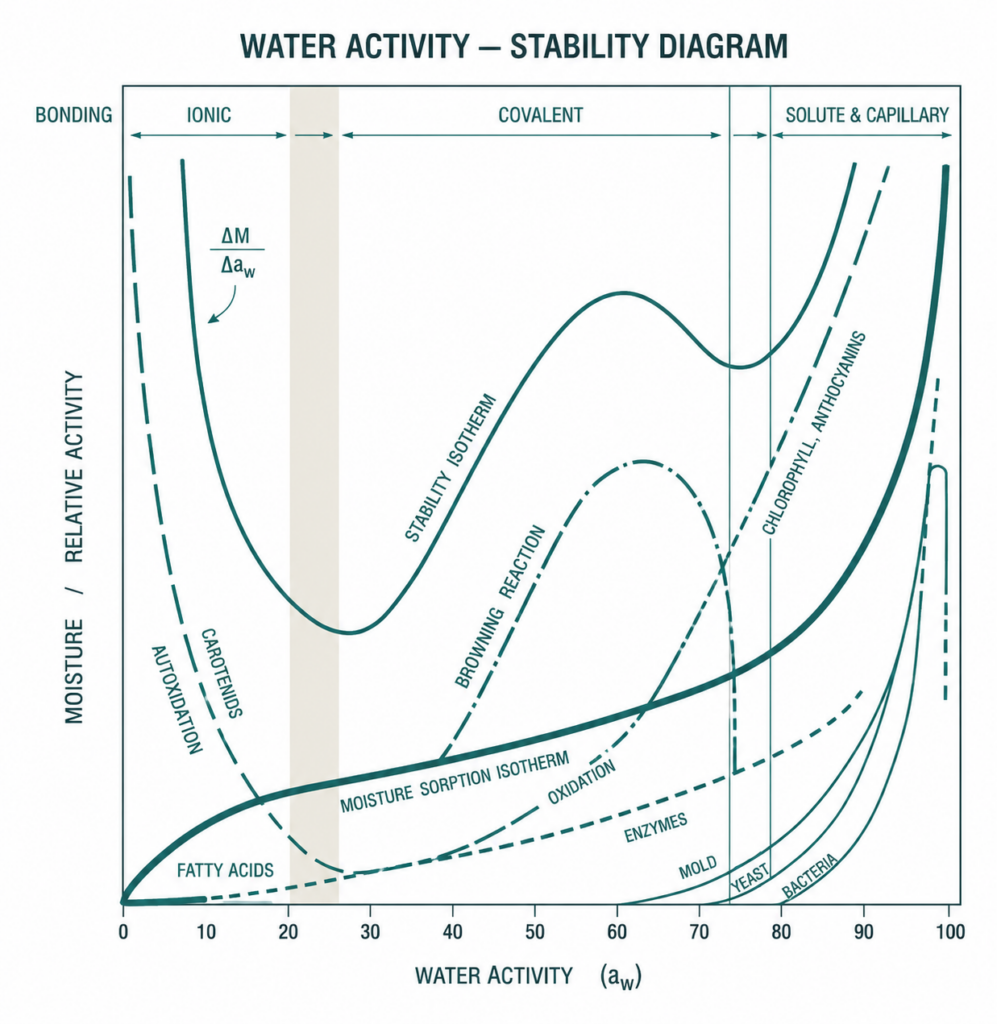
Water activity influences chemical reaction rates by lowering activation energy, increasing molecular mobility, and thereby increasing the reaction rate constant. As a result, reaction kinetics correlate more reliably with water activity than with moisture content. In general, reaction rates increase as water activity increases, although the exact relationship depends on both the product matrix and the reaction type (Figure 1). Many reactions exhibit maximum rates in the 0.70–0.80 aw range due to dilution effects at higher water activities; however, lipid oxidation uniquely increases at low water activity. Because spices contain significant amounts of essential oils, they are especially susceptible to oxidative rancidity, which contributes to the musty sensory characteristics described earlier. As illustrated in Figure 3, the optimal water activity range for minimizing degradative reactions in spices is approximately 0.30–0.50 aw. Within this range, lipid oxidation and other reaction pathways reach their minimum rates. At water activity values below this range, lipid oxidation accelerates, indicating that spices can, in fact, become too dry. So, in our previous example of setting a specification for chili powder, to prevent both clumping and rancidity, the acceptable water activity range could be set to 0.35-0.45 aw.
MODELING CHEMICAL REACTION RATE
To aid in determining the ideal water activity for slowing down chemical degradation, the reaction rate can be predicted using shelf-life models. To be effective, these models need to account for the effect of water activity and temperature. The only fundamental shelf-life model that includes both water activity and temperature is hygrothermal time (9). It is derived from a form of the Eyring (16) equation for rate change and Gibbs equation for free energy and is given by

ActiveX-Steuerelement where T is the temperature (K), R is the gas constant (J mol-1 K-1), Ea is the activation energy (J mol-1), B is the molecular volume ratio, aw is the water activity, and r0 is the rate at the standard state. In practice, the values for B, Ea/R and r0 will be unique to each situation and are derived empirically through least squares iteration. Once the constants are known, any temperature and water activity can be used with the hygrothermal time model to determine the rate of change at those conditions and hence the shelf life for a particular product, as it relates to that change. This model can then be used to establish the critical water activity where chemical degradation is at a minimum, thereby maximizing shelf life.
CRITICAL WATER ACTIVITY AND LOW MOISTURE INGREDIENT PASTEURIZATION
Recent high-profile recalls involving ingredients with low water activity (<0.70 aw) have highlighted the microbial contamination risks associated with low-moisture ingredients, including spices. While low water activity prevents the growth of pathogenic bacteria and other microorganisms [10], it is not a lethality step and does not eliminate existing microbial loads. Microorganisms present in spices remain dormant and will not proliferate, but if present in sufficient numbers, they can still cause infection when incorporated into a recipe. Furthermore, many pathogenic bacteria can survive for years at low water activity. Although dormant organisms may not pose an immediate risk when consumed directly, they can resume growth when introduced into high-moisture formulations where water activity supports microbial proliferation, potentially leading to foodborne illness.
In response to the recognized risk of microbial contamination in low-moisture ingredients, the Food Safety Modernization Act (FSMA) guidelines for Hazard Analysis and Risk-Based Preventive Control (HARPC) programs recommend incorporating pasteurization steps for these ingredients, along with monitoring activities to verify lethality. This means that spice processing will increasingly require some form of lethality treatment. While heat treatment is the most common approach, it poses challenges for spices due to their low water activity and the volatilization of essential oils at high temperatures. The time required to achieve lethality at a given temperature— known as the D-value—increases as water activity decreases [11]. Consequently, the time and temperature needed for effective lethality depend on the spice’s water activity, making it essential to identify a critical water activity where lethality efficiency is maximized. Because heat treatments are difficult to apply to spices, FSMA’s Hazard Analysis and Risk-Based Preventive Controls for Human Food: Guidance for Industry document (Section 4.3 Process Controls) provides alternative suggestions for achieving microbial lethality.
SUMMARY
Spices play a central role in cultural traditions and contribute significantly to the culinary identity of regions around the world. Their importance in enhancing the sensory experience of food makes it essential to maintain their safety and quality throughout their intended shelf-life. Water activity control is the key factor in achieving this stability. By processing spices to an optimal water activity—one that minimizes chemical reaction rates while preventing caking and clumping, and recognizing that excessively low water activity can accelerate lipid oxidation—producers can effectively maximize product shelf life, quality, and profitability. For additional guidance on applying the tools and models presented in this white paper to specific spice products or processing environments, please contact Dr. Brady Carter for further support.

REFERENCES
- Muggeridge, M. and M. Clay. “Introduction.” In Handbook of Herbs and Spices. Ed K.V. Peter. 1st Ed,
Cambridge, England: Woodhead Publishing Limited, 2001. 1-12.
- Aguilera, J. M., & del Valle, J. M. (1995). Structural changes in low moisture food powders. In G. V Barbosa-
Canovas & J. Welti-Chanes (Eds.), Food preservation by moisture control: Fundamentals and Applications
ISOPOW Practicum II (pp. 675–695). Lancaster, PA: Technomic Publishing Company.
- Shelf life analysis of spices – Eurofins blog – https://www.eurofins.in/food-testing/blog/shelf-life-analysis-
of-spices/
- Cavallaro E, Date K, Medus C, Meyer S, Miller B, Kim C, Nowicki S, Cosgrove S, Sweat D, Phan Q, Flint J,
Daly ER, Adams J, Hyytia-Trees E, Gerner-Smidt P, Hoekstra RM, Schwensohn C, Langer A, Sodha SV,
Rogers MC, Angulo FJ, Tauxe RV, Williams IT, & Behravesh CB. (2011). Salmonella typhimurium infections
associated with peanut products. N Engl J in Dynamic Environment and Conceivable Ways of Its Mitigation. Indian J Microbiol 64, 267–286 (2024). https://doi.org/10.1007/s12088-023-01176-4
- Sheth AN, Hoekstra M, Patel N, Ewald G, Lord C, Clarke C, Villamil E, Niksich K, Bopp C, Nguyen TA, Zink
D, & Lynch M. (2011). A national outbreak of Salmonella serotype Tennessee infections from contaminated
peanut butter: a new food vehicle for salmonellosis in the United States. Clin Infect Dis 53(4):356–62.
- Sheth AN, Hoekstra M, Patel N, Ewald G, Lord C, Clarke C, Villamil E, Niksich K, Bopp C, Nguyen TA, Zink
D, & Lynch M. (2011). A national outbreak of Salmonella serotype Tennessee infections from contaminated
peanut butter: a new food vehicle for salmonellosis in the United States. Clin Infect Dis 53(4):356–62.
- Saltmarch, M., & Labuza, T. P. (1980). Influence of relative humidity on the physicochemical state of lactose
in spray-dried sweet whey powders. Journal of Food Science, 45(5), 1231–1236,1242.
- Tsourouflis, S., Flink, J. M., & Karel, M. (1976). Loss of structure in freeze-dried carbohydrate solutions: effect of temperature, moisture content and composition. Journal of the Science of Food and Agriculture, 27, 509–519.
- Carter, B. P., Syamaladevi, R. M., Galloway, M. T., Campbell, G. S., & Sablani, S. S. (2017). A Hygrothermal
Time Model to Predict Shelf Life of Infant Formula. In U. Klinkesorn (Ed.), Proceedings for the 8th Shelf Life International Meeting (pp. 40–45). Bangkok, Thailand: Kasetsart University.
- Beuchat, L. (1983). Influence of water activity on growth, metabolic activities and survival of yeasts and
molds. Journal of Food Protection 46(2):135-141.
- Syamaladevi, R. M., Tang, J., Villa-Rojas, R., Sablani, S., Carter, B., & Campbell, G. (2016). Influence of Water Activity on Thermal Resistance of Microorganisms in Low-Moisture Foods: A Review. Comprehensive Reviews in Food Science and Food Safety, 15(2), 353–370.
Get in touch and learn more about your specific application and its possibilities! sales@novasina.ch


