
WATER ACTIVITY IN SOY SAUCE AND ASIAN SAUCES: SAFETY, PH AND LOW-SODIUM REFORMULATION
Soy sauce has been produced for centuries using salt, fermentation and carefully controlled formulations to create a product that is flavorful, stable and, in many cases, suitable for ambient storage. The same principle applies to many other Asian sauces, including fish sauce, hoisin sauce, teriyaki sauce, stir-fry sauces and sweet-and-sour sauces.
What is changing is the formulation.
Consumer demand for reduced-sodium foods is encouraging manufacturers to lower the salt content of products that have traditionally relied heavily on salt as part of their preservation system. While this can provide nutritional benefits, removing salt also changes one of the fundamental physicochemical properties responsible for product stability: water activity (aw).
This creates an important question for product developers and quality teams: if sodium is reduced, does the formulation still provide the same microbiological safety margin?
Water activity helps answer that question. Together with pH and other preservation hurdles, aw can be used to understand whether microorganisms are capable of growing in a sauce, how formulation changes influence product stability and whether an existing shelf-stable formulation remains within its validated operating range.
Measurements performed by Novasina on a range of commercial-style Asian sauces illustrate just how strongly formulation can influence water activity. Across 15 sauces, measured values ranged from 0.7547 aw for fish sauce to 0.9491 aw for hoisin sauce. Even products carrying the same general description, such as soy sauce, showed substantial differences depending on formulation.
The practical conclusion is important: a product cannot be assumed to have a particular water activity simply because it is called soy sauce, fish sauce or teriyaki sauce. Water activity must be determined from the actual formulation.
Water Activity of Soy Sauce and Other Asian Sauces
To investigate how formulation influences water activity, Novasina measured 15 sauce samples at 25°C using the ISO 18787 stability mode. The samples covered traditional soy sauces, reduced-sodium formulations and a variety of other sauces commonly used in Asian cuisine.
| Sample Type | Water Activity | Repeatability | Test Time (min) |
|---|---|---|---|
| Hoisin Sauce | 0.9491 | 0.0009 | 30 |
| Low Sodium Soy Sauce Type 1 | 0.9244 | 0.0004 | 21 |
| Sweet & Sour Sauce | 0.9154 | 0.0009 | 21 |
| Brewed Soy Sauce | 0.9054 | 0.0009 | 10 |
| Soy Sauce Type 1 | 0.9016 | 0.0006 | 17 |
| Bang Bang Sauce | 0.8940 | 0.0009 | 10 |
| Less Sodium Soy Sauce Type 2 | 0.8856 | 0.0003 | 18 |
| Stir-Fry Sauce | 0.8785 | 0.0004 | 17 |
| Low Sodium Soy Sauce Type 3 | 0.8666 | 0.0003 | 17 |
| Teriyaki Sauce | 0.8663 | 0.0004 | 18 |
| Mongolian Stir-Fry and Marinade | 0.8466 | 0.0009 | 17 |
| Soy Sauce Type 2 | 0.8342 | 0.0007 | 14 |
| Coconut Aminos – Soy Sauce Replacement | 0.8168 | 0.0009 | 21 |
| Soy Sauce Type 3 | 0.8071 | 0.0036 | 14 |
| Fish Sauce | 0.7547 | 0.0021 | 10 |
Table 1. Water activity, repeatability and measurement time of different sauce samples measured at 25°C using ISO 18787 stability mode.
The range is remarkable. The three conventional soy sauces alone ranged from approximately 0.81 to 0.90 aw, while the corresponding reduced-sodium versions were consistently higher. Hoisin sauce was close to 0.95 aw, whereas fish sauce was only about 0.75 aw.
This variation shows why water activity can be valuable during both product development and routine quality control. A formulation name, salt claim or historical recipe is not a substitute for measuring the actual thermodynamic state of water in the finished product.
Why pH Alone Does Not Tell the Whole Story
Sauce manufacturers traditionally pay close attention to pH, and for good reason. Many sauces are acidified or develop acidity during fermentation, and low pH can strongly restrict the growth of pathogenic microorganisms.
But pH and water activity measure fundamentally different properties; pH describes the activity of hydrogen ions and therefore the acidity of the product. Water activity describes the thermodynamic availability of water.
A product can have a low pH and high water activity, or a comparatively neutral pH and low water activity. There is no universal relationship that allows one value to be calculated reliably from the other.
This makes the two parameters especially powerful when used together.
A sauce with relatively high aw may still be microbiologically stable because its pH provides the dominant preservation hurdle. Another product may have a higher pH but sufficient salt, sugar or other dissolved solids to reduce aw to a level that prevents the growth of relevant organisms. Many traditional sauces rely on both mechanisms simultaneously.
This is the basis of hurdle technology: rather than relying on one extreme preservation condition, several independent factors work together to restrict microbial growth.
How Water Activity and pH Work Together
The interaction between pH and water activity is also reflected in the FDA Food Code. For foods that are not heat-treated, or are heat-treated but not subsequently packaged, Table B of the 2022 Food Code uses the combination of pH and aw to distinguish non-TCS foods from products requiring further assessment.
| Water Activity | pH < 4.2 | pH 4.2–4.6 | pH >4.6–5.0 | pH >5.0 |
|---|---|---|---|---|
| <0.88 | Non-TCS | Non-TCS | Non-TCS | Non-TCS |
| 0.88–0.90 | Non-TCS | Non-TCS | Non-TCS | Product Assessment |
| >0.90–0.92 | Non-TCS | Non-TCS | Product Assessment | Product Assessment |
| >0.92 | Non-TCS | Product Assessment | Product Assessment | Product Assessment |
Adapted from FDA Food Code 2022, Table B. The table applies to the specific food/process conditions defined by the Food Code and should not be interpreted as a universal manufacturing shelf-stability specification.
The table illustrates the principle particularly well. At less than 0.88 aw, water activity alone places a product in the non-TCS region of this specific framework regardless of pH. At higher water activity, increasingly strong pH control is required. A product above 0.92 aw, for example, falls into the non-TCS region only when pH is below 4.2 under the conditions represented by Table B.
The broader lesson for sauce formulation is more important than any single number: water activity and pH should be evaluated together rather than treated as interchangeable measurements.
Actual commercial classification and shelf-stability validation must also consider the manufacturing process, packaging, preservatives, intended storage conditions and applicable regulatory requirements.
Why Low-Sodium Soy Sauce Requires New Water Activity Data
Salt is not present in soy sauce only for flavor. Sodium chloride is also a powerful contributor to water activity control.
Dissolved salt interacts with water and reduces its chemical potential. When salt is removed from a formulation, more water can become thermodynamically available even if the total amount of water in the product has not changed dramatically.
This makes reduced-sodium reformulation particularly interesting from a food-safety perspective.
Novasina compared three conventional soy sauces with corresponding lower-sodium versions. In every pair, the reduced-sodium formulation had the higher water activity.
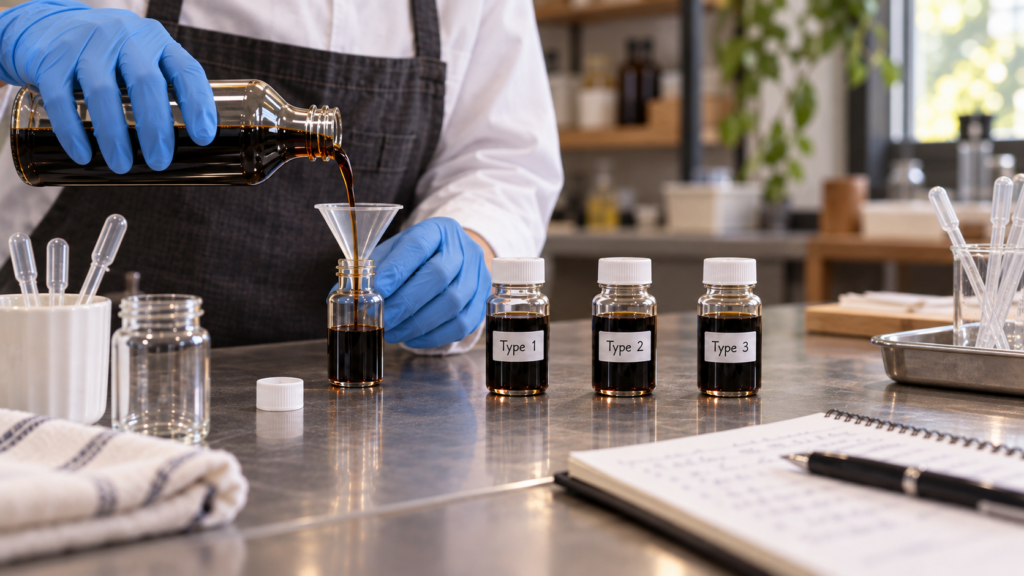
| Soy Sauce | Traditional Formulation | Reduced-Sodium Formulation |
|---|---|---|
| Type 1 | 0.9016 | 0.9244 |
| Type 2 | 0.8342 | 0.8856 |
| Type 3 | 0.8071 | 0.8666 |
Table 2. Water activity comparison between conventional and reduced-sodium formulations of three soy sauce products.
The direction of the change is consistent across all three products, but the magnitude is formulation-dependent. This is an important finding because it demonstrates why a generic correction factor cannot be applied when sodium is reduced.
The complete formulation determines the final aw. Sugars, amino acids, hydrolyzed proteins, fermentation-derived solids and other dissolved compounds also interact with water. Consequently, the safety margin of a reduced-sodium formulation cannot be predicted from sodium concentration alone.
For R&D teams, the implication is straightforward: when salt is reduced, water activity and pH should be re-measured as part of the reformulation process rather than assuming the original product’s stability characteristics still apply.
If the new formulation moves outside the previously validated stability range, additional hurdles may need to be considered, such as stronger pH control, preservatives, thermal treatment, refrigeration or another validated preservation strategy.
What Is Water Activity?
Water activity describes the thermodynamic state of water in a product rather than simply the amount of water present.
It is defined as the ratio between the partial vapor pressure of water above a sample and the saturated vapor pressure of pure water at the same temperature:
aw = p / p₀
Pure water has a water activity close to 1.00, while progressively lower values indicate that interactions with dissolved or structural components have reduced the chemical potential of water.
Water activity is also related to equilibrium relative humidity:
ERH (%) = aw × 100
A product at 0.85 aw will therefore tend toward equilibrium with an atmosphere of approximately 85% relative humidity at the same temperature.
The scientific basis goes further. Water activity is connected to the chemical potential, or partial molar Gibbs free energy, of water:
Δμw = RT ln(aw)
where Δμw is the difference in chemical potential of water from its reference state, R is the universal gas constant, T is absolute temperature and aw is water activity.
This relationship is why describing aw simply as “free water” can be misleading. A value of 0.50 aw does not mean that 50% of the water is free or that the water possesses exactly 50% of the energy of pure water. Water activity is a thermodynamic ratio that reflects how water behaves in the system. That distinction becomes extremely important in highly formulated products such as sauces.
Water Activity Is Not the Same as Moisture Content
Moisture content measures how much water a product contains. Water activity describes the energetic state of that water. The two properties are related through the product’s moisture sorption behavior, but they are not interchangeable. This is particularly relevant for sauces because dissolved salt, sugars, amino acids and other solids can strongly reduce water activity while the product remains physically liquid and contains a large quantity of total water.
A fish sauce at approximately 0.75 aw and a hoisin sauce at approximately 0.95 aw can both appear as high-moisture liquid products, yet their ability to support microbial growth is very different. For microbiological stability, the quantity of water is therefore less informative than how available that water is to microorganisms.
Water Activity and Microbial Growth in Sauces
Microorganisms need water to maintain cellular structure, metabolic activity and reproduction. When the water activity of the surrounding product is lower than the organism can tolerate, water is drawn from the cell, osmotic stress increases and growth eventually stops.
Different organisms have different minimum water activity requirements. This creates characteristic microbial growth limits. Most pathogenic bacteria require relatively high water activity. Staphylococcus aureus is one of the more osmotolerant pathogenic bacteria and may grow under aerobic conditions down to approximately 0.86 aw under favorable conditions. Many spoilage yeasts and molds tolerate lower values, while specialized osmophilic yeasts such as Zygosaccharomyces rouxii can grow at values close to 0.62 aw. Below approximately 0.60 aw, microbial proliferation is generally considered unable to occur. The values in the original Novasina application study illustrate the much broader range of tolerances across bacteria, yeasts and molds.
These limits are useful scientific reference points, but they are not stand-alone product specifications. Actual microbial growth is influenced simultaneously by pH, temperature, preservatives, nutrient availability, oxygen conditions and other factors. This is precisely why sauces are such a good example of hurdle technology.
Traditional Sauce Formulation Is Hurdle Technology in Practice
Long before water activity or microbiology could be measured, sauce producers discovered through experience that particular combinations of salt, fermentation and other ingredients created stable products.
Modern science helps explain why those formulations worked. Salt lowers water activity. Sugars and other soluble solids can contribute further to aw reduction. Fermentation generates organic acids that lower pH. Some formulations contain additional ingredients with antimicrobial effects. Processing and packaging then provide further barriers.
No single hurdle necessarily explains the entire stability of the product. Instead, the combined environment becomes unfavorable for growth.
This also explains why reformulation must be approached carefully. Changing one ingredient can alter one hurdle without obviously changing the appearance or flavor of the product. Sodium reduction is a particularly relevant example because an ingredient traditionally used for both sensory and preservation purposes is deliberately decreased. The formulation may still taste like soy sauce, but its microbial environment is no longer identical.
Measuring Water Activity in Fermented and Acidic Sauces
Sauces present another analytical challenge: many contain volatile compounds. Fermentation can generate organic acids and other volatile components, while formulations may contain vinegar, flavor compounds or alcohols. These compounds can interact with certain water activity measurement technologies.
Chilled-mirror instruments determine dew point by cooling a mirror until condensation occurs. Volatile substances capable of co-condensing with water can interfere with this process. Even AQUALAB notes that volatile compounds, including acetic acid, can cause unstable chilled-mirror readings or extended measurement times.
Resistive electrolytic sensors can also be affected by prolonged exposure to acidic vapors, so sensor protection remains important. Novasina addresses this with a dedicated acid filter, designed to adsorb acidic volatile compounds before they reach the electrolytic sensor.
The original Novasina study provides useful practical evidence. Triplicate measurements without the acid filter did not immediately impair instrument performance for most tested sauces, although fish sauce, stir-fry sauce and teriyaki sauce produced observable effects. Prolonged exposure to the acidic volatiles across the sample group eventually influenced sensor behavior. For this reason, Novasina recommends the acid filter for routine sauce measurements. Importantly, adding the filter did not meaningfully increase the reported measurement times.
This is also consistent with ISO 18787, which recognizes multiple aw measurement principles and notes that products containing volatile compounds may require specific equipment adaptations. ISO 18787:2017 remains the current international standard for water activity determination in food, having been reviewed and confirmed in 2023.
Rather than claiming that one sensor principle is universally suitable for every sample, the scientifically stronger approach is to select and protect the sensor according to the actual sample matrix.
From Product Development to Routine Quality Control
For an established sauce formulation, routine water activity measurement can verify that normal raw-material and processing variation has not moved the product outside its defined specification. The measurement becomes even more important when the formulation changes.
During sodium reduction, ingredient substitution or development of a new sauce, aw should be evaluated together with pH and the other validated hurdles. Once a suitable formulation has been established, those values can then become quantitative production specifications rather than assumptions based on recipe history.
This approach also improves troubleshooting. If a reformulated sauce unexpectedly requires refrigeration, develops yeast or mold problems, or loses the expected stability margin, comparing the new aw and pH against the original formulation can immediately show whether the underlying preservation system has changed.
For global producers, the same principle can help maintain consistency across sites. Different raw materials, ingredient suppliers or formulations can create products that appear similar but have different water activity values. Water activity therefore serves not only as a food-safety parameter, but as an objective way to understand what formulation changes have actually done to the product.
The Key Takeaway
Soy sauce and other Asian sauces demonstrate one of the most important principles in food preservation: safety and shelf stability usually come from a system of interacting hurdles, not from one measurement alone.
Salt and other dissolved solids can reduce water activity, while fermentation and acidification reduce pH. Together with processing, hygienic manufacturing and packaging, these factors create an environment that restricts microbial growth.
The Novasina measurements show that water activity varies widely even within the same broad sauce category. The 15 products tested ranged from approximately 0.75 to 0.95 aw, and every reduced-sodium soy sauce tested had a higher water activity than its corresponding traditional formulation.
That makes one conclusion especially important for today’s product developers:
When the formulation changes, do not assume the preservation system remains unchanged. Measure it.
By evaluating water activity together with pH and the other validated product hurdles, manufacturers can develop lower-sodium products while maintaining the safety, stability and quality expected from the original formulation.
Frequently Asked Questions About Water Activity in Soy Sauce
What is the water activity of soy sauce?
There is no single water activity value for soy sauce. In Novasina’s measurements, the conventional soy sauces tested ranged from approximately 0.81 to 0.90 aw, while reduced-sodium variants ranged from approximately 0.87 to 0.92 aw. The actual value depends on the complete formulation and should therefore be measured rather than assumed.
Does reducing sodium increase the water activity of soy sauce?
It can. Salt lowers water activity by reducing the chemical potential of water. In all three paired products measured by Novasina, the lower-sodium formulation had a higher aw than the corresponding conventional soy sauce. The size of the increase differed by formulation, demonstrating that sodium concentration alone cannot predict the final value.
Is soy sauce shelf-stable because of its water activity?
Water activity can be an important hurdle, but it is rarely the only one. Traditional soy sauces may also rely on pH, fermentation, salt, other dissolved solids, processing and packaging. The relative importance of each hurdle depends on the formulation.
Is pH or water activity more important in sauces?
Neither is universally more important. They measure different properties and can work together to restrict microbial growth. Some sauces depend primarily on acidity, others more strongly on reduced aw, and many rely on both.
What water activity makes a sauce non-TCS?
Under FDA Food Code 2022 Table B, which applies to foods that are not heat-treated or are heat-treated but not packaged, products below 0.88 aw fall in the non-TCS region regardless of the pH categories shown in the table. At higher aw values, the required pH becomes progressively lower or a Product Assessment may be required. This table should not be interpreted as a universal shelf-stability approval for every commercially manufactured sauce.
Can fermented or acidic sauces interfere with water activity measurements?
Yes. Volatile organic acids and other volatile compounds can interfere with some sensor technologies. Novasina therefore recommends an acid filter when routinely testing sauces with its resistive electrolytic sensor. ISO 18787 similarly recognizes that products containing volatile compounds may require equipment adaptations.
Scientific and Regulatory References
Beuchat, L.R. (1983). Influence of water activity on growth, metabolic activities and survival of yeasts and molds. Journal of Food Protection, 46(2), 135–141.
Leistner, L. (2000). Basic aspects of food preservation by hurdle technology. International Journal of Food Microbiology, 55(1–3), 181–186.
U.S. Food and Drug Administration. Food Code 2022, definition of Time/Temperature Control for Safety Food, Table B.
ISO 18787:2017. Foodstuffs — Determination of water activity. International Organization for Standardization.

Get in touch and learn more about your specific application and its possibilities! sales@novasina.ch


